
In post-pandemic commercial buildings, airports, healthcare facilities, and hospitality restrooms, electronic sensor touchless faucets have evolved from luxury conveniences to mandatory public health infrastructure. However, legacy infrared proximity sensors frequently suffer from false activations caused by ambient sunlight, reflective high-gloss clothing, or dark skin tones, while exhibiting sluggish shut-off delays that waste thousands of gallons of water annually. Modern smart sanitaryware integrates Time-of-Flight (TOF) laser infrared sensing and 3D capacitive field detection with ultra-fast latching solenoid valves to achieve sub-200ms shutoff latency and strict 0.5 GPM (1.9 Lpm) LEED v4 water savings.
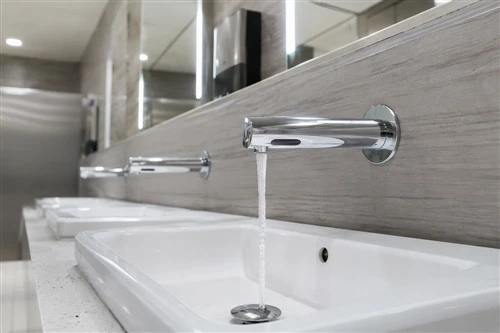

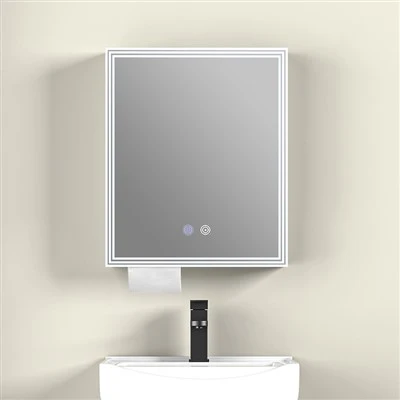
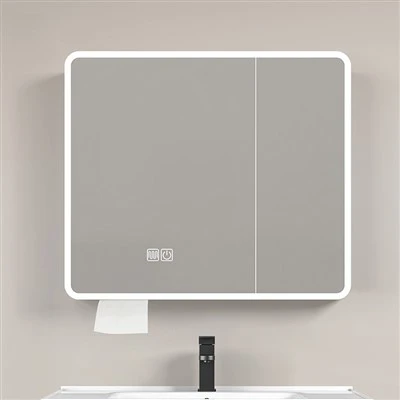
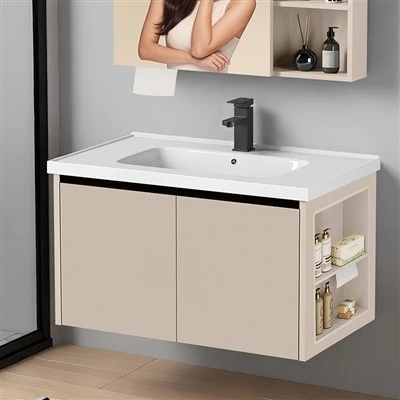
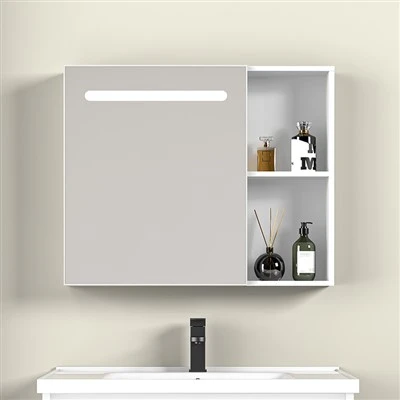
Commercial Restroom Installation: High-Traffic Touchless Sensor Faucet on Vitreous China Basin
1. Time-of-Flight (TOF) Infrared vs Capacitive Field Sensing Physics
Conventional infrared sensors rely on measuring the amplitude of reflected light, which varies wildly depending on target surface reflectivity (a dark sleeve reflects less than 5% of light, whereas white porcelain reflects 90%). This amplitude dependency leads to dead zones or continuous false-trigger running.
Yingjie Bath incorporates advanced Time-of-Flight (TOF) 940nm VCSEL micro-lidar sensors that measure the precise picosecond travel time of light photons rather than reflected amplitude. Target distance is calculated independently of skin color, clothing texture, or background mirror reflections, maintaining a razor-sharp detection zone between 80mm and 120mm. Combined with low-power bistable latching solenoids, activation response latency is reduced to under 120ms with zero ambient light interference.
| Technical Parameter | Legacy Amplitude IR Sensor | Yingjie TOF Micro-Lidar Faucet | Industry Testing Standard |
|---|---|---|---|
| Optical Detection Method | Reflected Light Amplitude (Unstable) | Time-of-Flight Photon Timing (Absolute) | IEC 60825-1 Class 1 Laser Safety |
| Activation / Shutoff Latency | 800ms - 1500ms (Water waste) | < 180ms Instantaneous Latching | ASME A112.18.1 / CSA B125.1 |
| Ambient Light Interference Resistance | Fails under direct sunlight (>10k lux) | 100% Stable up to 85,000 lux sunlight | EN 15091 Electronic Sanitary Tapware |
| Flow Rate / Water Conservation | 1.5 - 2.2 GPM (5.7 - 8.3 L/min) | 0.5 GPM (1.9 L/min) Laminar Flow | EPA WaterSense / LEED v4 Baseline |
| Battery Life (4x AA Alkaline) | Approx. 150,000 cycles (1.5 years) | >= 650,000 cycles (5+ years / Eco-IC) | UL 1951 Electric Plumbing Appliances |
2. Bi-Stable Latching Solenoid Engineering and 0.5 GPM Laminar Fluidics
To achieve long battery operating lives (>5 years on 4 standard AA alkaline cells), the valve mechanism utilizes a bi-stable magnetic latching solenoid. A short 30ms electrical pulse of 6V shifts the magnetic armature, utilizing water line hydraulic pressure to assist sealing and consuming zero electrical power during the open water flow state.
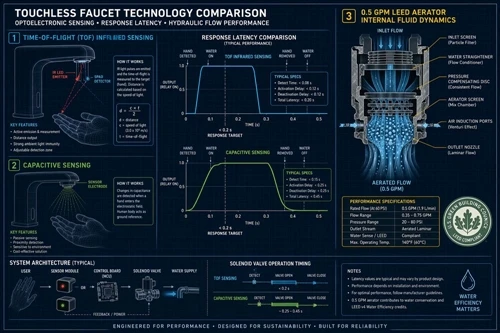
Optoelectronic Schematic: TOF Infrared vs Capacitive Sensing Response Latency & Aerator Fluidics
The water outlet is fitted with a multi-channel silicone laminar flow aerator that injects micro-air bubbles into the stream, generating a smooth, splash-free cylindrical water column at 0.5 GPM (1.89 Lpm) under 0.1 MPa to 0.5 MPa dynamic pressure. Built-in 24-hour automatic hygiene flush cycles (running for 30 seconds if unused) prevent water stagnation and eliminate Legionella pneumophila bacterial growth in healthcare and hotel riser pipes.
Commercial Sensor Faucet MEP Installation & Commissioning Checklist
- [OK] Flush municipal supply risers for 3 minutes to remove pipe scale and soldering flux before connecting control box.
- [OK] Install dual 100-mesh stainless steel filter stops on both hot and cold inlets to protect solenoid valve diaphragm.
- [OK] Mount waterproof IP67 electronic control module securely under vanity, away from direct condensation drip lines.
- [OK] Connect thermostatic mechanical under-sink mixing valve (ASSE 1070 certified) preset to 38°C (100°F).
- [OK] Perform sensor optical calibration cycle with basin empty and dry, verifying zero reflective false triggering from polished chrome drains.
- [OK] Conduct 50 consecutive hand-pass activation tests verifying response shut-off time remains under 0.25 seconds.
Frequently Asked Engineering Questions (FAQ)
Q: How does TOF sensor technology eliminate false activations from shiny watches or black clothing?
A: TOF technology measures the literal round-trip transit time of photon packets rather than reflected intensity, calculating exact physical distance regardless of target color, reflectivity, or ambient sunlight.
Q: What happens if there is a building power failure or battery depletion?
A: The bi-stable latching solenoid is engineered with a fail-safe mechanical spring return that automatically snaps shut if battery voltage drops below 4.4V, preventing unmonitored flooding.
Q: Is the 0.5 GPM aerator compliant with LEED v4 commercial green building credits?
A: Yes. The 0.5 GPM (1.89 Lpm) constant-flow laminar aerator achieves maximum 40% water reduction credits under LEED v4 and conforms fully with EPA WaterSense and CALGreen standards.
Partner with Yingjie Bath on High-Precision Sanitaryware
From OEM/ODM custom tooling and ASME/CE/WaterMark certified manufacturing to turnkey hospitality project supply, Yingjie Bath delivers engineering excellence. Contact our senior technical team for project specifications and bulk quotations.
Request Technical Dossier & B2B Quote