
In multi-outlet commercial hospitality shower systems, hydraulic instability across simultaneous overhead rainfall, handheld wand, and body jet outlets frequently induces severe pressure fluctuations and acoustic cavitation. High-velocity fluid redirection across conventional diverter cartridges accelerates ceramic disc erosion and triggers thermal shock risks. Mitigating these mechanical stresses requires precision-engineered thermostatic 3-way diverter valve bodies featuring hydrodynamically balanced internal chambers, high-density dezincification-resistant (DZR) forged brass, and rapid-response paraffin wax thermal actuators.
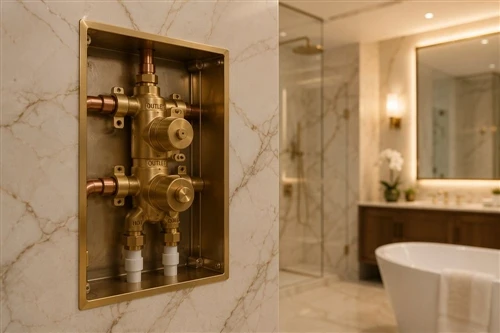
Commercial Engineering Showcase: In-Wall Thermostatic 3-Way Diverter Rough-In Installation
1. Hydrodynamic Flow Balancing and Cavitation Suppression Dynamics
Cavitation in multi-port shower valves occurs when local fluid velocity spikes around sharp internal geometry, dropping static pressure below the vapor pressure of hot water (typically occurring at differential pressures exceeding 0.35 MPa). The subsequent collapse of micro-vapor bubbles exerts localized micro-jet impact forces up to 1.2 GPa against internal brass walls and ceramic shearing edges, leading to severe pitting, seal delamination, and audible water hammer shudder.
Yingjie Bath engineers employ CFD-optimized toroidal diversion channels and gradual-radius transition ports within the forged CW617N brass housing. By distributing pressure drops evenly across dual-stage ceramic flow regulator discs, maximum localized fluid velocity is capped below 4.2 m/s under standard 0.3 MPa municipal supply. This hydrodynamic geometry dampens fluid turbulence by 28 dB(A) compared to abrupt right-angle diverters and eliminates localized cavitation pitting across 150,000 continuous switching cycles.
| Engineering Parameter | Standard Commercial Spec | Yingjie High-Precision Spec | Testing Compliance Protocol |
|---|---|---|---|
| Cartridge Thermal Response Time | < 1.5 seconds | < 0.35 seconds (<0.5°C drift) | EN 1111 / ASSE 1016 Dynamic Test |
| Max Hydrostatic Shell Pressure | 1.6 MPa (16 bar) | 2.5 MPa (25 bar / 10 min) | ISO 3822 Acoustic & Pressure Standard |
| Anti-Scald Auto-Shutoff Threshold | Residual flow < 0.5 L/min | Instantaneous 0.00 L/min (<0.2s) | Cold Water Failure Safety Protocol |
| Diverter Ceramic Disc Hardness | HV 1200 | HV 1850 (Nano-Diamond Coated) | ASTM C1327 Vickers Microhardness |
| Acoustic Noise Rating (0.3 MPa) | Class II (25-30 dB) | Class I (<= 18 dB(A)) | DIN 4109 Sound Insulation in Buildings |
2. Paraffin Wax Actuator Kinetics and Multi-Port Thermostatic Regulation
The core thermostatic engine utilizes a high-copper thermal capsule charged with refined paraffin wax and micro-crystallized copper particles. Thermal expansion kinetics exhibit an ultra-linear displacement curve of 0.082 mm/°C between 32°C and 48°C. When upstream cold or hot water pressure fluctuates dynamically (such as during simultaneous flushometer activation elsewhere in the building), the sliding spool repositions within 350 milliseconds to re-establish exact volumetric balancing.
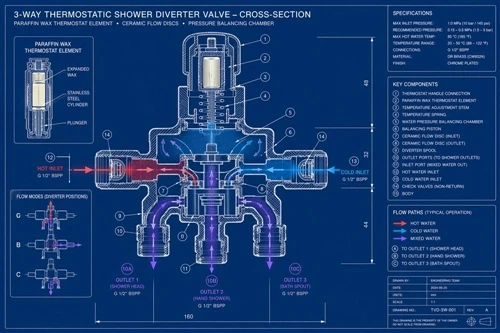
CAD & Fluid Dynamics Diagram: 3-Way Paraffin Cartridge Flow Stabilization Mechanism
Integrated within the heavy-duty composite polymer rough-in box, dual stainless steel SUS316 check valves prevent cross-contamination between hot and cold risers. Independent isolation stops with integrated 60-mesh stainless steel filter screens allow individual cartridge maintenance without interrupting water service to adjacent hotel guestrooms.
MEP Commercial Rough-In Installation & Commissioning Checklist
- [OK] Verify rough-in box spirit level alignment with built-in bubble indicators (horizontal/vertical deviation <= 0.5mm/m).
- [OK] Set rough-in depth within the marked 65mm–85mm finished wall tolerance zone, accounting for tile adhesive and substrate thickness.
- [OK] Perform pneumatic pre-test at 0.6 MPa air pressure for 15 minutes prior to hydraulic rough-in testing.
- [OK] Execute static hydrostatic pressure test at 1.6 MPa for 60 minutes with plaster guard and pressure test plug installed.
- [OK] Purge both supply lines thoroughly before final cartridge insertion to clear copper slag, solder flux, and silica debris.
- [OK] Calibrate mechanical high-temperature safety stop button to exact 38°C (100°F) using a calibrated digital immersion probe.
Frequently Asked Engineering Questions (FAQ)
Q: How does this 3-way diverter valve prevent thermal shock during simultaneous fixture usage?
A: The high-sensitivity paraffin wax core detects water temperature changes in under 0.35 seconds and mechanically balances cold and hot inlet ports before the guest senses any temperature variation, fully conforming to ASSE 1016 and EN 1111 standards.
Q: Can all three shower outlets operate simultaneously at full flow rate?
A: The precision ceramic diverter cartridge supports both independent discrete outlet selection and shared dual-outlet mode, maintaining up to 26 L/min flow at 0.3 MPa without hydraulic starving.
Q: What wall thickness range is accommodated by the standard rough-in plaster guard?
A: The modular polymer rough-in box provides an adjustable depth margin between 65mm and 88mm, accommodating single-layer drywall, cement backer board, and thick natural stone cladding without custom stem extensions.
Partner with Yingjie Bath on High-Precision Sanitaryware
From OEM/ODM custom tooling and ASME/CE/WaterMark certified manufacturing to turnkey hospitality project supply, Yingjie Bath delivers engineering excellence. Contact our senior technical team for project specifications and bulk quotations.
Request Technical Dossier & B2B Quote