Freestanding bathtubs in contemporary luxury resorts and wellness retreats are increasingly specified in solid surface mineral composites over conventional acrylic or enameled cast iron. However, lower-grade composite bathtubs utilizing cheap unsaturated polyester resins and calcium carbonate (chalk) fillers suffer from rapid yellowing, micro-porosity moisture absorption, and thermal shock cracking under 60°C water cycling. Premium architectural solid surface bathtubs achieve generational durability through homogenous gelcoat-free casting, optimal 65% aluminum trihydrate (ATH) mineral ratios, and high-purity methyl methacrylate (PMMA) polymer matrices.
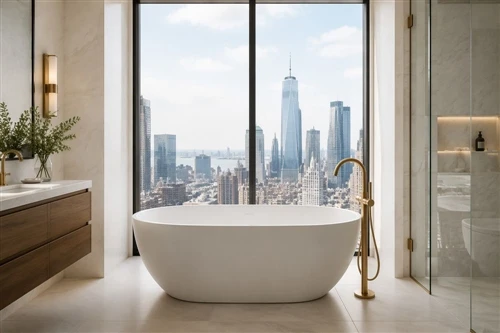
Architectural Bathroom Showcase: Freestanding Matte Solid Surface Stone Composite Bathtub
1. ATH Mineral Formulation and High-Purity PMMA Polymer Matrix
The structural and thermal stability of solid surface composite relies on the synergy between its inorganic mineral filler and synthetic polymer binder. Aluminum Trihydrate (Al(OH)3), derived from refined bauxite, provides superior fire retardancy (UL 94 V-0 rating), natural UV resistance, and ultra-high chemical inertness compared to soft calcium carbonate.
Yingjie Bath enforces a strict 65% ATH to 35% PMMA/MMA formulation with zero added polyester fillers. Under vacuum centrifugal casting at -0.098 MPa, air bubbles are evacuated from the liquid matrix prior to thermal curing. This yields a non-porous homogenous material with Barcol hardness exceeding 58 BH and a water absorption rate of less than 0.04%, allowing surface scratches to be fully restored with 1000-grit abrasive pads without exposing sub-layers.
| Material Property | Low-End Resin Composite (CaCO3) | Yingjie Pure Acrylic Solid Surface | Testing Standard Protocol |
|---|---|---|---|
| Mineral Filler Composition | 60% Ground Limestone (CaCO3) | 65% Refined Aluminum Trihydrate (ATH) | X-Ray Diffraction Mineralogy |
| Polymer Resin Matrix Type | Unsaturated Polyester Resin (UPR) | 100% Pure Acrylic (PMMA / MMA) | FTIR Spectroscopic Analysis |
| Barcol Hardness (Indentation) | 32 - 40 BH (Prone to scratching) | >= 58 BH (High scratch resistance) | ASTM D2583 Barcol Impressor |
| Thermal Shock Resistance (15°C - 75°C) | Fails at < 250 cycles (Cracks) | Passes > 1,500 continuous cycles | EN 14516 Bathtub Thermal Cycle Test |
| Stain & Chemical Resistance | Stains with iodine/hair dye in 2h | 100% Stain Removable with pad | ANSI Z124.1.2 Stain Resistance Test |
2. Vacuum Curing Kinetics and Monolithic Structural Integrity
The monolithic casting process takes place in precision CNC-machined aluminum alloy molds heated to 65°C. Following high-shear degassing, the catalyzed mixture undergoes controlled exothermic polymerization inside multi-stage thermal curing ovens over 8 hours. This eliminates differential internal shrinkage stresses and prevents edge warpage (maintaining perimeter rim flatness within +/- 1.0mm across 1800mm length).
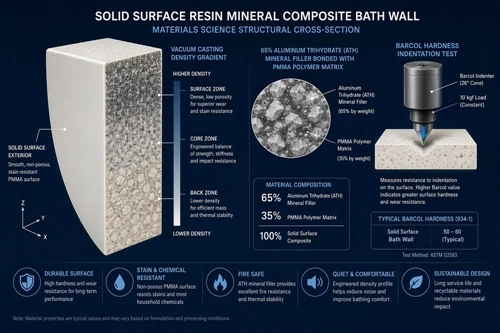
Materials Science Diagram: Polymer Matrix ATH Dispersion & Barcol Hardness Indentation Structure
Because the material is 100% homogenous throughout its 25mm wall thickness, it lacks any brittle outer gelcoat layer that could chip or blister over time. The silky matte tactile finish is achieved via 5-stage automated orbital water polishing, delivering a warm-touch thermal effusivity that retains bath water temperature 40% longer than pressed steel or enameled iron.
Solid Surface Bathtub MEP Installation & Inspection Checklist
- [OK] Verify subfloor structural capacity is certified for minimum 450kg dynamic load (bathtub tare weight ~160kg + 250L water + occupant).
- [OK] Level bathtub base using adjustable internal stainless steel leveling feet, ensuring 100% contact across all 4 corner load points.
- [OK] Install quick-connect brass drop-in bathtub drain kit (Island Tub Drain) to guarantee zero-leak sub-floor alignment.
- [OK] Apply flexible braided stainless steel waste connector with integrated P-trap, maintaining minimum 1:50 downward drainage slope.
- [OK] Conduct 100% hydrostatic overflow flood test for 2 hours to verify welded overflow channel hermetic sealing.
- [OK] Protect matte bathtub surface with heavy-duty felt protective cover during ongoing bathroom tiling and ceiling construction.
Frequently Asked Engineering Questions (FAQ)
Q: Can scratches and burns on this matte stone bathtub be repaired on-site?
A: Yes. Because the bathtub is solid and non-porous throughout with no gelcoat layer, scratches, cigarette burns, or stubborn stains can be completely erased in minutes by gently buffing with a standard 800–1200 grit sanding sponge.
Q: How does pure acrylic solid surface prevent UV yellowing in bathrooms with large windows?
A: Pure PMMA acrylic resin combined with 65% ATH filler possesses intrinsic photolytic stability, achieving Level 5 UV resistance (ISO 4892-2) with zero detectable color shift (Delta E < 1.0) over 10 years of daylight exposure.
Q: What is the weight comparison between this solid surface tub and cast iron?
A: A 1700mm solid surface tub weighs approximately 140kg–165kg, providing substantial stability without requiring structural floor reinforcement typically mandated for 250kg+ cast iron tubs.
Partner with Yingjie Bath on High-Precision Sanitaryware
From OEM/ODM custom tooling and ASME/CE/WaterMark certified manufacturing to turnkey hospitality project supply, Yingjie Bath delivers engineering excellence. Contact our senior technical team for project specifications and bulk quotations.
Request Technical Dossier & B2B Quote