
Three quotes for the same one-piece toilet arrive on your desk: $26.50 FOB, $29.00 FOB, and $31.80 FOB. The cheapest number looks like an easy decision - until the first container lands with glaze pinholes across 6% of the units and a water absorption certificate that does not cover your market's import standard.
A sanitary ware quote is a contract for a specification, not a price. Until every quote is normalized onto one spec sheet - same body, same firing profile, same finish standard, same commercial terms - the numbers are simply not comparable.
1. Why Raw FOB Prices Mislead
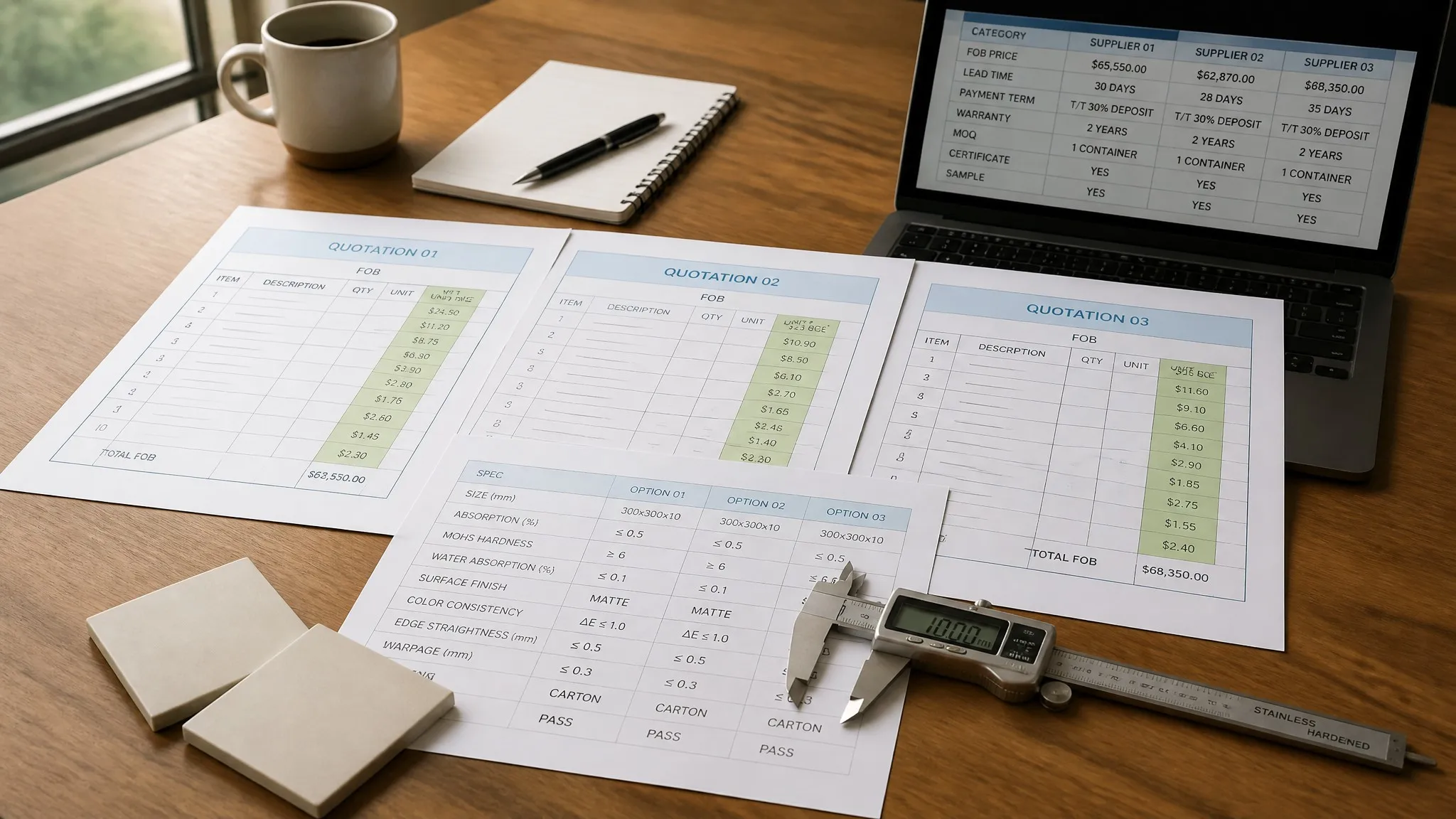
A single FOB number is the least informative item on a quote. It is the sum of at least four things that each supplier mixes in a different proportion: the physical specification, the production process behind it, the commercial terms attached to it, and the documentation the supplier is willing to stand behind. Two quotes can show the same $28.00 and describe a $24 product plus $4 of process risk on one side, and a $30 product discounted on the other.
Normalizing quotes is a three-step discipline:
- One spec sheet. Every quote answers the same seven-point specification baseline (Section 2), written into the RFQ before prices come back.
- One commercial frame. Same Incoterm, same port, same order volume, same payment schedule (Section 3).
- One evidence list. Every spec claim carries a named document you can request before deposit (Section 5).
Once the three quotes sit on the same grid, the residual differences are real choices - and they are exactly what you should negotiate.
2. The Seven-Point Spec Baseline
Write these seven lines into every RFQ and refuse to compare quotes that skip one of them. They cover everything that determines whether the fixture survives ten years in service or fails in eighteen months.
1. Body material - vitreous china. The body must be stated as vitreous china (kaolin–feldspar–quartz), not earthenware, fine fire clay, or "ceramic" without a class. The vitreous china toilet manufacturing process guide traces how the body is cast, dried, and fired - ask suppliers to confirm the body class in writing on the quote itself.
2. Firing profile - 1280°C. A true vitreous china body fires at 1260–1300°C, with most Chinese export lines running 1280°C and a 45–90 minute soak in a tunnel kiln. Below 1200°C the body is semi-vitreous: cheaper to fire, 1–3% water absorption, and a staining surface within two years. Firing temperature and kiln type belong in the quote's technical notes, not in a verbal promise. The tunnel kiln vs shuttle kiln comparison explains why the kiln type also changes cost and consistency.
3. Water absorption - ≤0.5%. Measured per ISO 10545-3, water absorption ≤0.5% is the export-grade line. A quote that states ≤0.8% or "0.5–1%" is a semi-vitreous product at a vitreous price. Stricter (≤0.2%) is available but raises the material and QC lines - our sanitary ware supplier cost breakdown shows exactly where that premium sits.
4. Glaze thickness - 0.8–1.2mm. Ask for the glaze thickness range and the method used to measure it (a glaze thickness gauge on a fired piece, or a cross-section). Budget fixtures glaze at 0.5–0.8mm; commercial-grade carries 0.8–1.2mm. The glaze is the part of the fixture that faces daily cleaning chemicals, so this line is where "cheap" shows up first.
5. Dimensional tolerance. Ceramic shrinks 8–12% in firing and holds roughly ±3–5mm on most external dimensions. What matters is not the average tolerance but the tolerance on critical dimensions - seat post hole centers, rough-in distance, wall-mount brackets. Our dimensional tolerance standards in ceramic sanitary ware article lists the numbers your QC team should verify on the first sample.
6. Certification scope. "CE certified" is not a spec. State which certificates apply to which model, which market, and their validity dates. A certificate covering one model of the range is a different product line than a certificate covering all exported models - and the price difference is real. Check whether the certificate is issued for the factory or for the model, and whether it is current.
7. Packaging spec. The quote should name the carton grade (e.g., 5-ply with an ECT rating), the inner protection (EPS or foam inserts), and the per-carton weight. Packaging runs 8–12% of FOB, and a downgraded carton is invisible until the first damage claim. Our export packaging standards for ceramic sanitary ware guide documents the grades and transit tests that separate an export spec from a packaging guess.
3. Commercial Terms That Change the Comparison
Four commercial terms move the real cost more than the unit price line, and they are the ones most often left out of a quote-to-quote comparison.
Incoterm. FOB, CIF, EXW, and DDP shift between $15 and $25 per unit in logistics cost. The Incoterms guide for sanitary ware importers explains where each term puts the risk and the freight markup. Compare all quotes on one term - usually FOB the same port - and add the destination costs yourself.
MOQ. MOQ is kiln economics, not policy. A factory firing 1,040 pieces per kiln load quotes MOQs that fit kiln cycles; the same product can carry a 200-unit MOQ difference between factories. Verify the MOQ against the factory production capacity assessment guide so you know whether the MOQ reflects a real production floor or a sales target.
Lead time. Pin the definition: production starts when materials are cast, not when the deposit clears. Ask for a calendar commitment split into mold/sample time, production time, and packing time. A quote at 45 days from a factory running at 95% capacity is a 60-day quote in practice.
Mold/tooling fee. Casting molds for a one-piece toilet run $6,000–18,000. The question is not whether tooling is charged but how: one-time upfront, amortized per unit, or silently buried in the unit price. "No tooling cost" on a brand-new model means the molds are buried somewhere. A reorder of the same model should carry near-zero tooling cost - our
shows how to audit the amortization schedule.
4. The Auditable Quote Comparison Table
The table below normalizes three quotes onto one grid. It is a worked example for demonstration - the prices are illustrative, not a quote from any specific factory. Every row pairs a required parameter with the evidence you should request, so the comparison is auditable rather than asserted.
Specification assumed in this example: one-piece vitreous china toilet, body fired at 1280°C in a tunnel kiln, water absorption ≤0.5% (ISO 10545-3), glaze thickness 0.8–1.2mm, FOB a southern China port, order volume 300 units.
| Parameter | Baseline Spec (this buyer) | Supplier A | Supplier B | Supplier C | Evidence to Request |
|---|---|---|---|---|---|
| Body material | Vitreous china | Vitreous china | "Ceramic" (unstated) | Vitreous china | Body class stated in writing on quote |
| Firing profile | ≥1280°C, tunnel kiln | 1280°C tunnel | 1260°C shuttle | 1280°C tunnel | Kiln type + temp in technical notes |
| Water absorption (ISO 10545-3) | ≤0.5% | ≤0.3% | ≤0.8% | ≤0.4% | Batch test report per production lot |
| Glaze thickness | 0.8–1.2mm | 1.0mm | 0.6mm | 0.9mm | Glaze gauge record or QC sheet |
| Dimensional tolerance | ±3mm ext.; critical dims per drawing | ±3mm | ±5mm | ±4mm | Dimension report on fired sample |
| Certification scope | CE (model), cUPC, WaterMark | CE, model A only | cUPC claimed, no scope | CE + WaterMark, all models | Certificate PDF + scope page + validity |
| Packaging | 5-ply ECT carton, EPS inserts | 5-ply, ECT stated | 3-ply, no ECT | 5-ply, ECT stated | Carton spec sheet + drop test record |
| Incoterm | FOB Ningbo | FOB Ningbo | FOB Shekou | EXW | Proforma invoice line |
| MOQ | 300 units | 200 units | 500 units | 150 units | MOQ clause in written quote |
| Lead time | 35 days | 30 days | 45 days | 28 days | Casting-start + packing-end dates |
| Mold/tooling fee | One-time, itemized | $6,000 amortized | "No tooling" | $7,500 one-time | Tooling invoice or amortization schedule |
| FOB unit price | - | $26.50 | $29.00 | $31.80 | Line-item quote |
Reading the grid the way a buyer should: Supplier B is not cheaper at $29.00 than Supplier A at $26.50 - it is a different product (1260°C shuttle firing, ≤0.8% absorption, 0.6mm glaze, 3-ply carton, no certificate scope) wearing the same model name. Supplier A's $26.50 needs the mold amortization added over your volume, and its CE certificate covers only one model. Supplier C is the most expensive per unit but the only quote whose certification scope, packaging spec, and evidence list match the baseline without qualification. The auditable grid does not choose the supplier for you - it forces the differences into the open where you can price them.
5. How to Audit Each Row
A comparison table is only as good as the evidence behind each cell. Attach a document name to every row before you compare:
- Body and firing: written confirmation of the body class and kiln parameters in the quote's technical notes; a kiln log excerpt if the factory will share one.
- Water absorption: batch test reports per ISO 10545-3 - one report per production lot, not a single "sample tested" line. Our quality control and testing protocol for ceramic sanitary ware lists the report format to demand.
- Glaze thickness: a glaze thickness gauge record on a fired piece, or a cross-section photo; the measurement method must be named.
- Tolerances: a dimension report on the first fired sample, measured against your drawing; sign off before mass production starts.
- Certification: the certificate PDF with its scope page and validity date; verify the model number matches your SKU.
- Packaging: the carton spec sheet with the ECT rating, plus a drop-test record or video for the packed carton.
- Commercial terms: the MOQ clause, the proforma invoice with the Incoterm, and the tooling invoice or amortization schedule.
A supplier who provides all seven evidence items within five working days is quoting you a product. A supplier who pushes back on the evidence list is usually protecting a spec difference that the grid would expose.
6. Red Flags in Any Quote Comparison
- A quote that refuses to state firing temperature or body class.
- Water absorption quoted as a range that includes 0.8% or higher.
- Glaze thickness below 0.8mm sold as "commercial grade."
- "CE certified" without a model number or scope page.
- MOQ that changes when you ask for it in writing.
- "No tooling cost" on a brand-new model.
- A 30-day lead time from a factory running at full capacity.
- Any supplier who will not put the spec sheet on the quote.
The Bottom Line
You cannot compare sanitary ware supplier quotes until you have normalized them onto one spec sheet, one commercial frame, and one evidence list. The seven-point baseline - vitreous china, 1280°C firing, ≤0.5% water absorption, 0.8–1.2mm glaze, dimensional tolerance, certification scope, and packaging - plus Incoterms, MOQ, lead time, and mold fees, turns three incomparable numbers into a grid you can audit. Send the grid with your next RFQ, request the evidence before the deposit, and let the spec sheet, not the sticker price, pick your supplier.
Frequently Asked Questions
Why can't I compare sanitary ware quotes on FOB price alone?
A FOB number is the sum of four things each supplier mixes in a different proportion: the physical specification, the production process, the commercial terms, and the documentation behind them. Two quotes at the same price can describe two different products. Normalize every quote onto one seven-point spec sheet (body, firing, water absorption, glaze thickness, tolerances, certification scope, packaging) plus one Incoterm, one port, one volume, and one evidence list before comparing prices.
Which spec parameters must match before comparing two quotes?
The seven-point baseline: vitreous china body, firing at 1280°C with a soak in a tunnel kiln, water absorption ≤0.5% per ISO 10545-3, glaze thickness 0.8–1.2mm, dimensional tolerances on critical dimensions, certification scope (model, market, validity), and packaging grade (carton ECT rating, inserts). Commercial terms must also match: Incoterm, MOQ, lead time definition, and how the mold/tooling fee is charged.
What does certification scope mean and why does it affect price?
Certification scope names which models, which markets, and which validity dates a certificate covers. "CE certified" without a model number is not a spec. A certificate covering one model of the range is a different product line than one covering all exported models, and the price difference is real. Always request the certificate PDF with its scope page and verify the model number matches your SKU.
How do MOQ, lead time, and mold fees change which quote is best?
MOQ is kiln economics, not policy - a factory firing 1,040 pieces per kiln load quotes MOQs that fit kiln cycles, so the same product can differ by 200 units between factories. Lead time should be defined from casting start, not from deposit clearing. Mold/tooling fees for a one-piece toilet run $6,000–18,000 and should be one-time and itemized; "no tooling cost" on a brand-new model means the molds are buried in the unit price, and reorders of an existing model should carry near-zero tooling.
What evidence should I request to audit a quote comparison?
Seven documents: batch water absorption test reports per ISO 10545-3 (one per production lot); a glaze thickness gauge record on a fired piece with the method named; a dimension report on the first fired sample; certificate PDFs with scope page and validity date; a carton spec sheet with ECT rating plus a drop-test record; the MOQ clause and proforma invoice with the Incoterm; and the tooling invoice or amortization schedule. A supplier who provides all seven within five working days is quoting a product, not a story.
📋 Get Quote Comparison Support for Your Next RFQ
Need help normalizing three quotes onto one spec sheet, verifying test reports, or auditing mold fees and lead times? Contact Yingjie Bath for spec sheet templates, evidence checks, and bulk pricing.
👉 Request Quote Comparison Support & Bulk Pricing