
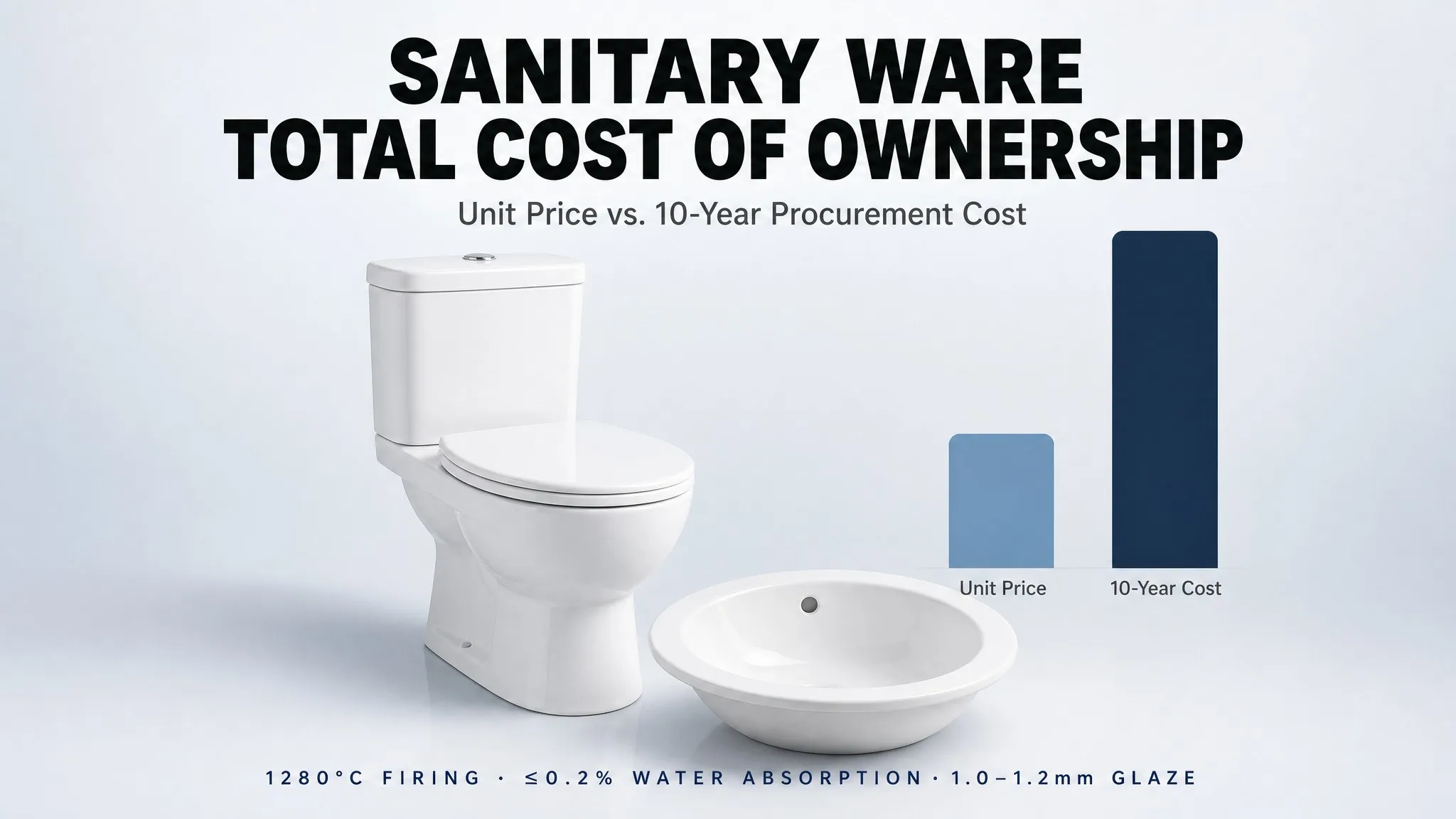
The $32 toilet costs more than the $45 toilet. That is not a typo, and it is not a rounding error. It is what happens when a procurement team compares FOB unit prices instead of the full cost of owning a fixture for ten years.
Two suppliers quote the same two-piece toilet. One quotes $32 FOB, the other $45. Over a 10-year procurement horizon, the $32 fixture accumulates freight, breakage, repair, and replacement costs that the $45 fixture never generates. This article breaks down the four cost layers between a unit price and a real procurement cost, then runs both fixtures through a complete 10-year model.
1. Why Unit Price Is the Least Reliable Number on a Purchase Order
Every sanitary ware quote contains one figure buyers trust instantly: the unit price. It is also the figure with the least predictive value for what the fixture will actually cost.
Unit price captures a single moment - the factory gate. Everything after that moment is a separate cost stream: ocean freight and port charges, transit breakage and its replacement cycle, in-service repairs, spare parts, and eventually full fixture replacement. Added together over ten years, these streams routinely exceed the purchase price of the fixture itself.
For ceramic sanitary ware, total cost of ownership (TCO) breaks down into four layers:
- Landed acquisition - FOB price plus freight, insurance, and port charges.
- Freight and container utilization - the per-unit share of the shipping container you pay for.
- Transit breakage and replacement - damaged units, their re-shipment, and installation labor.
- In-service failure and repair - glaze defects, cracked bodies, worn mechanisms, and premature replacement.
A budget-grade fixture wins layer one by a wide margin. It loses layers two through four by an even wider one.
2. Layer One: The Landed Acquisition Cost
The FOB price is the factory gate price. The landed cost is what you actually pay per unit after the container reaches your warehouse. For a 40ft High Cube container of 240 two-piece toilets shipped from Shenzhen to Los Angeles, the full stack is:
| Cost Item | Per Unit (USD) |
|---|---|
| FOB product price | $45.00 |
| Ocean freight ($3,800 / 240 units) | $15.83 |
| Marine insurance ($220 / 240) | $0.92 |
| Destination THC ($450 / 240) | $1.88 |
| Inland trucking ($850 / 240) | $3.54 |
| Total landed cost | $67.79 |
The difference between FOB and landed is $22.79 per unit - a 51% markup that appears nowhere in the quote. The Incoterm you sign determines where these numbers land on your P&L. The Incoterms guide for sanitary ware importers walks through FOB, CIF, and DDP cost structures for exactly this container size - including the $200–600 premium CIF adds over FOB through the supplier's freight markup.
3. Layer Two: Freight and Container Utilization
Freight is not a fixed cost per container. It is a fixed cost divided by how many units fit inside the container. That makes loading density a procurement decision, not a logistics footnote.
| Container Loading | Units Loaded | Freight per Unit |
|---|---|---|
| Base configuration | 300 sets | $12.67 |
| Optimized configuration | 350 sets | $10.86 |
Optimizing the load saves $1.81 per unit - $18,100 per 10,000 units before touching a single product price. Carton height reduction, tail-loading accessories, and mixed toilet-plus-basin loads typically improve density by 10–20%, which is why the container loading optimization guide treats loading plans as a line-item cost reduction. Importers who adopt systematic loading plans cut freight cost per unit by 8–15%.
4. Layer Three: Transit Breakage and Replacement
Ceramic sanitary ware is dense, brittle, and unforgiving in transit. Breakage is not a rare event; it is a rate that your packaging specification controls. The damage-rate economics for a 10,000-unit annual volume at $45 per unit landed:
| Damage Rate | Broken Units | Replacement Value |
|---|---|---|
| 1% | 100 | $4,500 |
| 3% | 300 | $13,500 |
| 5% | 500 | $22,500 |
| 8% | 800 | $36,000 |
The spread between a 1% and a 5% damage rate is $18,000 per 10,000 units - more than the entire price difference between budget and commercial-grade fixtures for the same volume. Every broken unit consumes freight twice, occupies warehouse space, triggers a claim process, and delays the project it was ordered for.
The lever here is packaging specification, not luck. A $1.50-per-unit packaging upgrade that moves the damage rate from 5% to 2% saves $13,500 of replacement value per 10,000 units - roughly a 90x return on the packaging investment. The export packaging standards guide documents the three-layer foam-plus-carton system, ISPM 15 pallet requirements, and ISTA 1A drop-test protocol that export-grade factories use to hold damage under 1–2%.
5. Layer Four: In-Service Failure, Repair, and Replacement
The last layer is the one most procurement teams never model: what the fixture costs while it is installed. In-service failures follow a predictable pattern in budget-grade ceramic - glaze defects and high porosity convert a $32 purchase into a repeated expense stream.
Two material properties decide the in-service cost curve:
- Water absorption. Vitreous china fired at 1280°C absorbs ≤0.2% water under ISO 10545-3. Semi-vitreous bodies absorb 0.5–3%. Absorbed moisture carries cleaning chemicals below the glaze line, producing permanent staining that surface cleaning cannot remove. The vitreous china manufacturing process guide traces how the 1280°C firing converts a kaolin-feldspar-quartz body into a glass-like matrix - the property that keeps a commercial fixture white for 20 years.
- Glaze thickness. Commercial-grade vitreous china carries a 1.0–1.2mm glaze layer. Budget fixtures typically glaze at 0.5–0.8mm. Under daily cleaning with acidic descalers, a thin glaze erodes to the body within 18–24 months. The glaze defect detection guide covers the pinhole, crawling, and crazing defects that shorten glaze service life before the fixture ever ships.
Every failed fixture generates a service event: a plumber visit, a spare part, or a full replacement. At an average $45 per repair event (service call plus minor parts) and $40 installation labor per replacement, the repair stream on budget-grade fixtures typically runs 3–5x higher than commercial-grade over ten years. A factory that documents all seven QC gates - from slip preparation to final packing - produces fixtures with measurably lower early-life failure rates. The complete sanitary ware QC testing protocol lists the exact tests to request before signing a contract.
6. The 10-Year Cost Model
Now the four layers are combined into a single model. Scenario: a property operator procures 1,000 two-piece toilets over a 10-year horizon - the volume of a mid-size hotel chain renovation program or a multi-building residential development.
Two bids:
- Budget grade: FOB $32, landed $52, 5% transit damage rate, 5–6 year in-service life (about half the installed base replaced once within 10 years), 2% annual repair-event rate.
- Commercial grade: FOB $45, landed $68, 2% transit damage rate, 15–20 year in-service life (about 8% of units replaced within 10 years), 0.6% annual repair-event rate.
| Cost Component (10 Years, 1,000 Units) | Budget Grade | Commercial Grade |
|---|---|---|
| Landed acquisition (1,000 units) | $52,000 | $68,000 |
| Transit breakage replacements (5% vs 2%, landed + $40 install) | $4,600 | $2,160 |
| In-service repair events (200 vs 60 @ $45) | $9,000 | $2,700 |
| Full fixture replacements (500 vs 80, landed + $40 install) | $46,000 | $8,640 |
| 10-Year Total | $111,600 | $81,500 |
| Per-Unit 10-Year Cost | $111.60 | $81.50 |
The $45 toilet costs $81.50/unit over 10 years.
10-Year Savings: $30,100 (27% lower) on 1,000 units
The "cheaper" fixture is 37% more expensive over the procurement horizon. Excludes downtime, claim administration, and labor for repeated replacements (typically 2× material cost per cycle).
7. The Procurement Checklist That Protects a 10-Year Budget
Total cost of ownership thinking converts into four verifiable specification clauses. Each one is checkable before you sign the PO:
- Material: vitreous china with water absorption ≤0.2% (ISO 10545-3 test report required) and firing temperature ≥1280°C.
- Surface: glaze thickness 1.0–1.2mm, measured by cross-section or ultrasonic gauge on production samples.
- Quality: factory QC records across all seven inspection gates - not just final sampling - plus third-party pre-shipment inspection results.
- Logistics: three-layer export packaging with ISTA 1A drop-test certification, a written container stuffing plan, and an Incoterm that matches your freight management capability.
Choosing the right Incoterm for your shipment volume is a TCO decision, not a paperwork preference. And the factory production capacity assessment guide explains how to verify that the factory quoting the low price can actually deliver consistent quality at the volume your 10-year plan requires - because a factory that throttles its kiln to chase orders ships the defects you will pay for in layer four.
Frequently Asked Questions
How do you calculate total cost of ownership for sanitary ware?
Add four cost layers over the procurement horizon: landed acquisition (FOB plus freight, insurance, and port charges), per-unit freight share, transit breakage and replacement, and in-service repair plus replacement. Compare suppliers on the 10-year sum, not the FOB unit price.
Why does a cheaper toilet cost more over 10 years?
In the 1,000-unit model, a $32 FOB fixture lands at $52, breaks at 5% in transit, and fails in service often enough that the 10-year total reaches $111.60 per unit. A $45 commercial-grade fixture lands at $68, breaks at 2%, and lasts 15–20 years - a 10-year total of $81.50 per unit. The cheaper fixture is 37% more expensive overall.
What water absorption rate should a sanitary ware specification require?
≤0.2% under ISO 10545-3, the vitreous china threshold achieved by firing at 1280°C. Semi-vitreous bodies at 0.5–3% absorption stain permanently, harbor bacteria below the glaze, and fail within 5–6 years in commercial use.
How much does transit breakage actually cost?
At $45 per unit landed, a 3% damage rate costs $13,500 per 10,000 units; 5% costs $22,500. A $1.50-per-unit packaging upgrade that cuts damage from 5% to 2% returns roughly 90x the investment.
Do freight decisions change unit economics?
Yes. Container loading optimization raises a 40ft container from 300 to 350 units, cutting freight from $12.67 to $10.86 per unit - $18,100 saved per 10,000 units. Pairing the right Incoterm with your freight management capability avoids $200–600 per container in avoidable premiums.
🛡️ Get a 10-Year Procurement Cost Assessment
Procuring sanitary ware for hotels, apartments, or construction projects? Contact Yingjie Bath for commercial-grade vitreous china specifications, ISO 10545-3 test reports, and bulk pricing.
👉 Request TCO Data Sheets & Bulk Quote