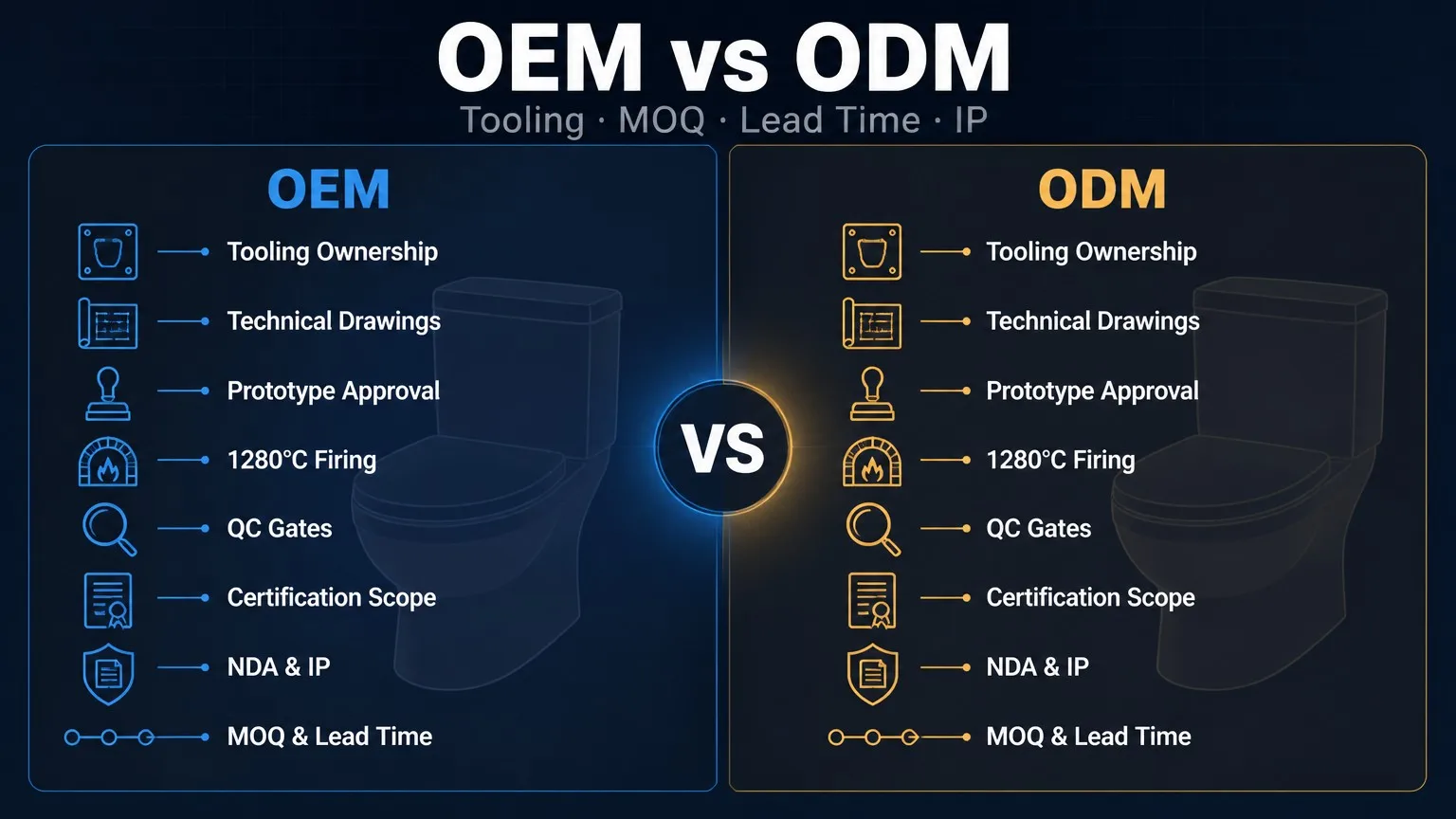
Private-label sanitary ware buyers face one decision before any other: OEM or ODM. The choice determines who owns the mold, who holds the drawings, who signs off the prototype, and who carries the intellectual property risk. Get it wrong, and you can pay $3,000 for a mold that legally belongs to the factory - or discover your "exclusive" toilet design being quoted to a competitor under a different badge.
This article compares both sourcing routes for ceramic sanitary ware across the variables that control cost and risk: tooling ownership, engineering data, prototype approval, production QC, and the MOQ/lead-time structure.
1. The Two Routes Defined
OEM (Original Equipment Manufacturer) means the factory manufactures to the buyer's design. The buyer supplies the drawings or pays for the tooling, owns the mold, and controls the specification. The factory contributes process know-how: slip formulation, casting, glazing, and kiln operation.
ODM (Original Design Manufacturer) means the factory supplies the design. The product already exists as a mold in the factory's tooling library. The buyer selects a model, makes limited changes, and the factory produces it under the buyer's brand.
The difference is not manufacturing - both routes run through the same casting, glazing, and 1280°C firing lines. The difference is who owns the design assets and who carries the development risk.
OEM vs ODM at a Glance
| Decision Variable | OEM | ODM |
|---|---|---|
| Design ownership | Buyer | Factory |
| Tooling (mold) ownership | Buyer - pays tooling fee | Factory - embedded in unit price |
| Technical drawings | Buyer supplies 2D/3D CAD package | Factory catalog technical data |
| Prototype cycle | Master model to golden sample | Existing sample, 7–15 days |
| Exclusivity | Contractual, enforceable | Rarely available |
| Typical MOQ | 300–1,000 pcs per SKU | 50–200 pcs per SKU |
| Development lead time | 60–90 days | 15–30 days |
| Unit price at volume | Lower - tooling amortized | Higher - design margin included |
| IP/NDA burden | High - buyer IP at stake | Low - factory IP at stake |
2. Tooling Ownership - the Mold Is the Product
Tooling ownership is the first clause to read in any sanitary ware contract. In slip casting, the "mold" is a hierarchy: the master model (CNC-machined resin model encoding the product geometry), the case mold (negative used to cast working molds), and the working molds (plaster or resin molds that receive the slip; plaster sets last roughly 200–400 casts, resin pressure-casting molds run tens of thousands of cycles).
Typical tooling fees for Chinese vitreous china factories: two-piece toilet $1,800–$3,500, countertop basin $600–$1,200, wall-hung urinal $1,200–$2,000.
In OEM sourcing, the buyer pays the tooling fee and must see the ownership clause in writing: "All molds, master models, and patterns are the exclusive property of the buyer. The factory shall not produce, replicate, or modify said tooling for any third party without the buyer's written consent." Without that clause, the mold is legally the factory's asset. In ODM sourcing, tooling belongs to the factory; the mold cost is embedded in the unit price.
Amortization math: $2,400 of tooling over a 500-unit first order adds $4.80 per unit; over 2,000 units it adds $1.20 per unit. The break-even against an ODM price premium of $3–5 per unit usually lands between 600 and 1,500 units.
3. Drawings and Engineering Data
OEM requires a complete engineering package: 3D CAD (STEP or IGES), 2D dimensional drawings with tolerances, surface finish and glaze color specification, and functional requirements. The factory designs the mold with shrinkage compensation - vitreous china shrinks 8–12% linearly during firing, so the master model is oversized by that factor.
For ODM, the factory supplies technical data and the buyer verifies it against local requirements - for example, seat post hole spacing against your seat supplier's pattern. Ceramic production holds ±3–5mm on most external dimensions; our guide to dimensional tolerance standards in ceramic sanitary ware manufacturing documents the numbers your QC team should check before committing to a model.
4. Prototype Approval
ODM samples ship in 7–15 days from existing molds. OEM development runs 25–45 days covering master model, case mold, first working molds, bisque sample, glazed sample, and pilot run. Approval is a gate, not a courtesy:
- Dimensional verification: rim flatness ≤1.5mm, seat post hole spacing, minimum wall thickness.
- Water absorption: ≤0.2% under ISO 10545-3 (boil test) - proves full vitrification at 1280°C.
- Flush function: flush volume within target, complete evacuation, no splash-back.
- Glaze color: ΔE ≤2.0 against the approved standard under D65 illumination.
- Fit checks: the actual seat, flush valve, and mounting hardware must fit the sample.
The signed-off sample becomes the golden sample - two sealed copies, one at the factory and one at the buyer. The PO must state: "Production must match the golden sample within the tolerances defined in Appendix B; deviations require written buyer approval before shipment."
5. 1280°C Firing and the QC Gates
Vitreous china reaches its mechanical properties only when fired to 1260–1300°C. Below that range the body stays porous, water absorption climbs above 0.2%, and the product fails the fundamental material test. The firing curve is visible in the QC records and the kiln type - a tunnel kiln with zone-controlled temperature holds ±5°C across the setting.
The QC system should gate production at seven points: raw material composition, slip viscosity and aging, green ware backlight inspection, bisque inspection, glaze application checks, post-fire inspection (the highest-rejection gate), and final packaging inspection. The full protocol is documented in our quality control testing protocol for ceramic sanitary ware.
Ask for the factory's post-fire first-quality yield before the PO. A stable line runs 85–92% first quality; below 80%, your lead time and price are absorbing the factory's waste.
6. Certification Scope
OEM: the buyer controls certification. The factory provides test data and the buyer certifies under their brand (ASME A112.19.2 and WaterSense in the US, EN 997/CE in Europe). The certificate names your model number.
ODM: check the certificate scope line - certificates list model numbers. If the certificate names model "CT-102" and your private label is "Model 2000", the certificate does not cover your SKU. Also check what the certificate does not cover: a WC flush certificate does not cover body water absorption; a basin load test does not cover glaze stain resistance.
7. NDA and IP Clauses
OEM transfers your intellectual property into a factory's hands. The contract stack should include five clauses:
- NDA: signed before drawings are released; two-year term minimum, surviving termination.
- Mold ownership: tooling is buyer property; no third-party use without written consent.
- IP assignment: all drawings and models created during development are assigned to the buyer.
- Non-circumvention: the factory may not sell to your end customers using your tooling or data.
- Design registration: US design patent or EU RCD in the destination market - a mold clause protects the tooling, only registration protects the shape itself.
For ODM, the IP risk runs the other way: the design belongs to the factory, and exclusivity is rare - when offered, it is priced as a buy-out of the tooling, which converts the deal into a de facto OEM arrangement.
8. MOQ and Lead-Time Decision Table
| Sourcing Route | Typical MOQ (per SKU) | Sample Lead Time | Production Lead Time |
|---|---|---|---|
| ODM, existing design | 50–200 pcs | 7–15 days | 15–30 days |
| OEM, tooling already stored at factory | 200–500 pcs | 7–10 days | 30–45 days |
| OEM, new tooling (standard models) | 300–1,000 pcs | 25–45 days (prototype) | 60–90 days total |
| OEM, high-complexity (one-piece, rimless, wall-hung) | 500+ pcs | 35–50 days | 75–100 days total |
MOQ is rarely a factory policy number - it is a kiln economics number. A factory firing 1,040 pieces per kiln load quotes MOQs that fit kiln cycles. Understanding how kiln throughput sets that floor is the subject of our guide to assessing a sanitary ware factory's true production capacity. Plan your freight booking against the production date, not the contract date.
9. The Decision Framework
The route decision condenses to control versus speed:
- Choose OEM when the design is your competitive edge, you have engineering capacity, and you can fund tooling and absorb 60–90 days of development. You own the mold, the IP, and the exclusivity.
- Choose ODM when speed to market and low MOQ matter more than exclusivity and the factory's existing design meets your market requirements.
- Consider the hybrid: an ODM base model with OEM-style modifications on co-invested tooling - partial exclusivity at roughly half the tooling cost.
📌 Before committing tooling or drawings to a factory, run the full supplier evaluation in our factory audit checklist for sanitary ware B2B buyers - it covers the tooling shop, mold life records, and QC documentation that this article assumes you will inspect.
Frequently Asked Questions
What is the difference between OEM and ODM sanitary ware?
OEM means the factory manufactures to the buyer's design: the buyer owns the drawings, pays for the tooling, and controls the specification. ODM means the factory supplies the design: the buyer selects an existing mold from the factory's tooling library. Both routes run through the same casting, glazing, and 1280°C firing lines; the difference is who owns the design assets.
Who owns the mold in OEM sanitary ware sourcing?
The buyer - but only if the contract says so. A mold ownership clause must state that all molds, master models, and patterns are the exclusive property of the buyer and cannot be used for third parties without written consent. Without it, the mold is legally the factory's asset. Typical tooling fees: two-piece toilet $1,800–$3,500, basin $600–$1,200, urinal $1,200–$2,000.
What is the typical MOQ for OEM vs ODM ceramic sanitary ware?
ODM existing designs: 50–200 pcs with 15–30 day lead time. OEM with stored tooling: 200–500 pcs, 30–45 days. OEM with new tooling: 300–1,000 pcs, 60–90 days total. High-complexity products start at 500+ pcs with 75–100 days. MOQ is largely a kiln economics number.
How long does OEM sanitary ware development take?
New OEM tooling follows a 25–45 day prototype cycle (master model, case mold, working molds, bisque sample, glazed sample, pilot run) plus 30–45 days of production - 60–90 days total. One-piece and rimless products run 75–100 days. ODM samples from existing molds ship in 7–15 days.
How do I protect my design when sourcing OEM sanitary ware?
Use five contract clauses: (1) NDA before drawings are released; (2) mold ownership naming the buyer as owner; (3) IP assignment for all drawings and models; (4) non-circumvention preventing direct sales to your customers; (5) design registration (US design patent or EU RCD) - a mold clause protects the tooling, only registration protects the shape itself.
🛡️ Get Your OEM/ODM Sourcing Plan
Planning a private-label sanitary ware line? Contact Yingjie Bath for mold ownership clause templates, prototype approval checklists, and MOQ/lead-time quotes.
👉 Request OEM/ODM Sourcing Consultation & Quote