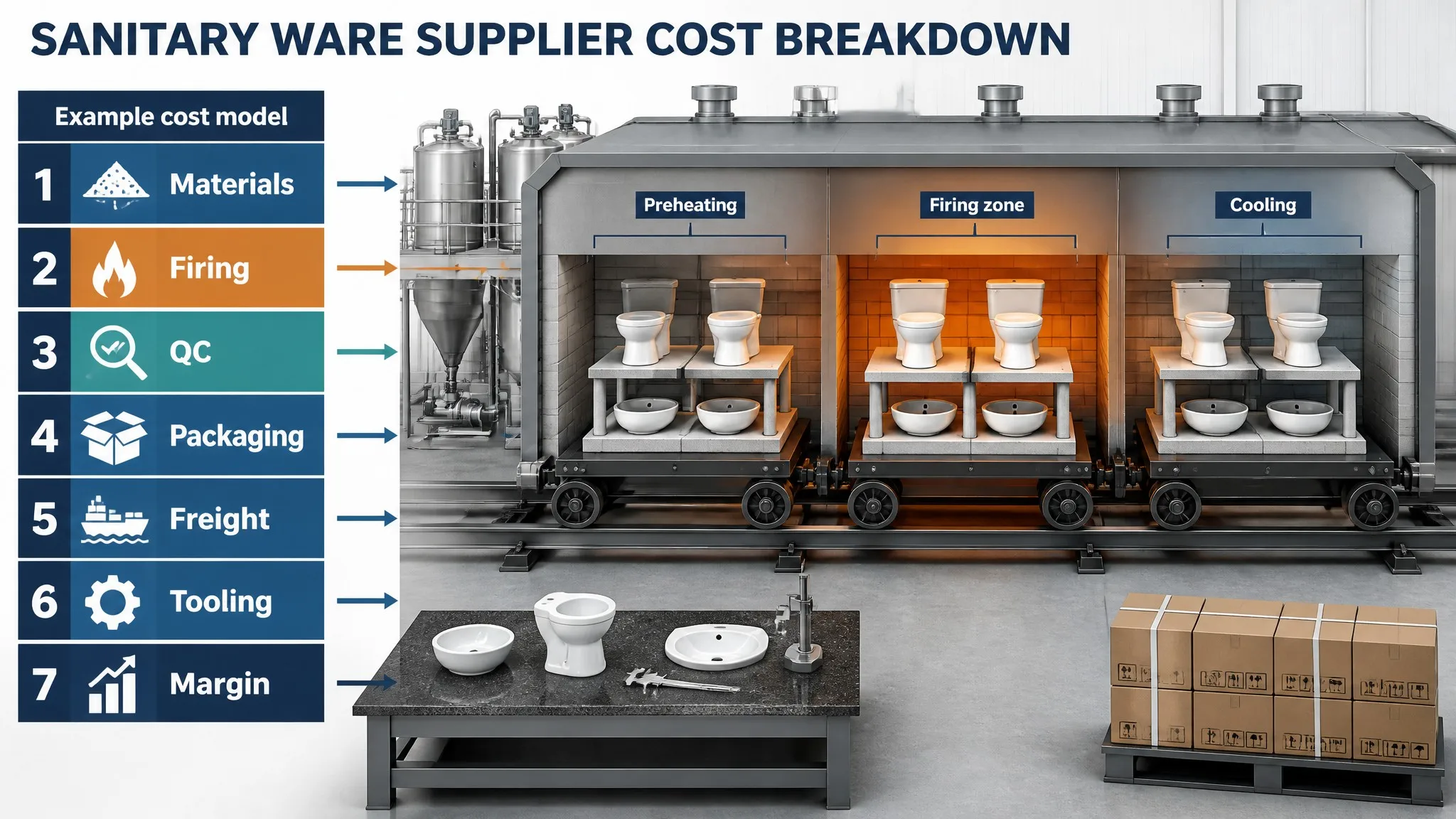
A factory quote for a ceramic toilet arrives as a single FOB price. Under that number sit seven distinct cost centers - raw materials, firing, quality control, packaging, freight, tooling, and margin. Each one moves independently, and each one is negotiable to a different degree.
Buyers who negotiate the total price without understanding the line items either overpay on a padded quote or push the price down into the range where the supplier quietly downgrades the spec.
1. The Seven Cost Centers in Every Quote
Every sanitary ware quote, from a $25 entry-level toilet to a $90 designer basin, is built from the same cost structure. The percentages shift with product size, firing temperature, and order volume, but the centers do not change.
| Cost Center | What It Covers | Typical Share of FOB Price |
|---|---|---|
| Raw materials | Body slip (kaolin, feldspar, quartz), glaze compounds, additives | 25–35% |
| Firing | Kiln energy, kiln furniture, firing labor share | 15–25% |
| Quality control | Incoming material tests, in-line inspection, final tests, packaging samples | 3–8% |
| Packaging | Export carton, foam inserts, corner protectors, pallet share | 8–12% |
| Freight | Inland trucking to port (FOB basis), container share of origin costs | 3–8% |
| Tooling | Mold sets and kiln furniture amortized over the order | 2–8% |
| Margin | Supplier profit and sales overhead | 8–20% |
Direct labor and factory overhead are real costs, but most suppliers spread them inside the firing, raw material, and QC lines rather than quoting them separately. When you request a line-item breakdown, ask which lines carry the labor - the answer tells you how the quote was built.
2. Raw Materials: The Floor Under Every Price
The body of a vitreous china toilet is a kaolin, feldspar, and quartz mixture, milled into slip, cast into molds, and fired. The raw material cost is fixed by the specification, not by the supplier's mood. Two spec decisions move this line the most:
- Water absorption target. A body formulated for ≤0.5% absorption uses a higher kaolin-to-filler ratio and finer milling than a body at 1.5–3%. The vitreous china manufacturing process article walks through slip preparation, casting, and drying - the stages where the body-material decision is locked in.
- Glaze thickness. Glaze compounds are among the most expensive inputs by weight. A 1.0mm glaze layer uses roughly 30% more glaze material than a 0.7mm layer. The difference is invisible in the showroom and very visible in the raw material line.
A rough floor for body and glaze material on a one-piece toilet is $8–12 at current clay and feldspar pricing. Any quote below that floor for a full-size one-piece unit is either using a thinner body, a lower-grade slip, or a spec you should read again.
3. Firing: The Energy Line
Ceramic bodies reach vitrification only at high temperature. A true vitreous china body fires at 1260–1300°C - most Chinese production lines run 1280°C with a 45–90 minute soak in a tunnel kiln. Below 1200°C you get a semi-vitreous body with 1–3% water absorption, which costs less to fire and fails faster in service.
Firing is the second-largest line because energy is expensive and the kiln runs continuously:
- Tunnel kilns fire products continuously and recover heat from the cooling zone, which spreads energy cost over high throughput. The tunnel vs shuttle kiln comparison explains why continuous production kilns hold a per-unit energy advantage.
- Shuttle kilns fire in batches, cool fully between runs, and consume 20–40% more energy per piece.
On a one-piece toilet, the firing line typically lands at $5–8 per unit depending on the local gas price, the kiln type, and the reject rate. Rejects are a hidden multiplier: a 5% firing reject rate adds 5% to the firing cost of every good piece that comes out of the kiln.
4. Quality Control: The Testing Line
QC costs look small on paper - 3–8% - but they are the cheapest insurance in the quote. A serious factory runs four layers of checks:
- Incoming material testing (clay plasticity, glaze slurry density, contamination).
- Greenware inspection before firing (cracks, warpage, wall thickness).
- Fired-piece testing: water absorption per ISO 10545-3, glaze thickness, glaze defects, and load tests.
- Pre-shipment sampling on packed cartons, including transit simulation.
The spec you negotiate determines the QC cost. Testing water absorption to ≤0.5% is routine; holding ≤0.2% and certifying every batch adds lab time and raises the line. Our quality control and testing protocol for ceramic sanitary ware lists the exact tests to request and the report formats to demand. A supplier who cannot produce batch test reports is quoting you a QC line they are not actually spending.
5. Packaging: The Carton That Protects the Product
Ceramic is heavy, brittle, and unforgiving in transit. Export packaging for sanitary ware means:
- 5-ply or 7-ply export carton with a stated edge crush test (ECT) rating;
- Foam or molded EPS inserts holding the fixture away from the carton walls;
- Corner protectors and strapping;
- Pallet configuration and per-pallet weight limits for container loading.
Packaging runs 8–12% of FOB because the materials are bulky and the carton grade is set by the destination logistics chain. Our export packaging standards for ceramic sanitary ware guide covers carton grades, pallet plans, and the transit tests that separate a packaging spec from a packaging guess.
Do not let this line get squeezed silently. A 7-ply carton downgraded to a 5-ply carton saves the supplier $0.30–0.50 per unit and costs you the first damage claim. If you want to cut packaging cost, cut the foam density or the pallet type - in writing - not the carton wall.
6. Freight: Origin Costs and Ocean Costs
Freight splits into two layers that buyers frequently confuse:
- Origin costs inside FOB. Inland trucking from the factory to the loading port, port handling, and the container stuffing share are inside the FOB price. This is usually $1.20–2.00 per unit for a factory within 200 km of the port.
- Ocean freight and destination costs. These sit outside FOB - ocean freight, marine insurance, destination terminal handling, and inland trucking to your warehouse. On a 40ft HC container with 240 one-piece toilets, ocean freight runs roughly $15–16 per unit at current transpacific rates.
The Incoterms guide for sanitary ware importers explains how each term shifts these costs between you and the supplier. For cost control, the practical question is not FOB vs CIF - it is whether the supplier's inland freight quote reflects the actual factory-to-port distance. Ask for the trucking line item; a factory that quotes the same inland freight from two different cities is padding the line.
7. Tooling: The Mold Amortization Trap
Casting molds are not cheap. A one-piece toilet needs multiple mold sets - tank, bowl, and base sections - and a production mold set runs roughly $6,000–18,000 depending on the model and the number of cavities. Factories amortize this cost across the order volume and show it as a per-unit tooling line.
Two things to check in every quote:
- The amortization schedule. 1,000 units at $10,000 tooling = $10.00 per unit. 5,000 units = $2.00 per unit. The line should fall as volume rises, and it should fall exactly.
- The reorder behavior. Once a model is in production, the molds exist. A reorder of the same model should carry near-zero tooling cost. If your repeat quote still shows a full tooling line, the supplier is using tooling as margin in disguise.
Tooling is the one line where order volume genuinely moves the price - consolidate your annual volume into fewer SKUs and the tooling line shrinks without any price negotiation at all.
8. Supplier Margin: Where the Negotiation Actually Lives
Typical supplier margin on FOB sanitary ware is 10–20%. Margins this size are legitimate - they cover sales overhead, warranty risk, financing, and profit. The problem is not margin; it is hidden margin:
- Material substitutions billed at full spec price (glaze downgrade, carton downgrade).
- Tooling charged twice across two orders of the same model.
- Inland freight quoted above actual trucking cost.
- Reject-rate risk priced into the quote at 8% when the factory's actual firing reject rate is 3%.
A quote at $28 FOB with honest line items can be a better deal than a quote at $30 with three padded lines. You cannot tell which one you have until you ask for the breakdown.
9. A Transparent Example Cost Model (Labeled Example)
The table below is an example cost model, not a quote from any specific factory. It is a worked example for a one-piece vitreous china toilet, FOB a southern China port, built from the cost structure described above. Use it as a reference shape - your actual numbers will differ with specs, gas prices, and order volume.
Specification assumed in this example: body fired at 1280°C in a tunnel kiln, water absorption ≤0.5% (ISO 10545-3), glaze thickness 0.8–1.0mm, 5-ply export carton with EPS inserts, 240 units per 40ft HC, order volume 1,500 units.
| Line Item | Per Unit | Share of FOB | Note |
|---|---|---|---|
| Raw materials (body slip, glaze, additives) | $9.50 | 29% | Kaolin, feldspar, quartz, glaze compounds |
| Firing energy (tunnel kiln, 1280°C) | $6.50 | 20% | Gas, kiln furniture share, reject allowance |
| Direct labor & overhead | $4.80 | 15% | Casting, glazing, finishing, assembly (spread across lines) |
| Quality control & testing | $1.70 | 5% | Water absorption, glaze thickness, drop test, pre-shipment sample |
| Export packaging | $3.30 | 10% | 5-ply carton, EPS inserts, corner protectors, pallet share |
| Inland freight to port | $1.60 | 5% | Trucking share per unit (FOB basis) |
| Tooling amortization | $1.10 | 3% | Molds amortized over 1,500 units |
| Subtotal cost | $28.50 | 87% | - |
| Supplier margin | $4.30 | 13% | 15% on cost |
| FOB price (example) | $32.80 | 100% | EXAMPLE - not a factory quote |
Read the example the way a negotiator should: the product cost floor is $28.50, of which firing and raw materials are $16.00 - 56% of the FOB price. Any saving target above a few dollars per unit has to come from the spec (glaze thickness, absorption target, packaging grade) or from volume (tooling amortization, consolidated freight), because the material and energy floor does not move.
FOB: $32.80/unit + Ocean freight ~$15.80 + Insurance, THC, trucking ~$6.30
Landed Los Angeles: ≈ $55/unit
Total markup over FOB ≈ 67% - of which supplier margin is only 13 points. Most of what you pay after FOB is logistics, not supplier profit.
10. Target-Cost Negotiation Framework
Negotiation works in the opposite direction from quoting. The supplier builds up from costs; you should build down from your target landed cost.
Step 1 - Set the FOB ceiling
Start from your sell price or project budget. Subtract destination costs: ocean freight per unit, insurance, destination THC, inland trucking, duties, and customs fees. What remains is the maximum FOB price that makes the project work.
Step 2 - Request a line-item breakdown
Ask for: material spec sheet, firing parameters (kiln type, temperature, soak), batch QC test reports, carton and pallet spec, and the inland freight quote. A supplier who refuses to break down a quote is usually hiding a margin in one of the soft lines - freight, tooling, or QC.
Step 3 - Anchor the spec before the price
Negotiate the spec sheet first: water absorption target, glaze thickness, packaging grade, and test documentation. Every spec you fix narrows the range of prices the supplier can honestly quote. Compare quotes only on identical spec sheets.
Step 4 - Spend volume where the fixed costs are
Tooling amortization and container utilization respond directly to order size. Consolidate SKUs, extend order volume, or commit to repeat orders of the same model - the tooling line collapses and the freight per unit drops with fuller containers.
Step 5 - Compare three quotes on the same grid
Same spec sheet, same Incoterm, same port, same volume. Line-by-line differences beyond ±8% on raw materials or firing mean the specs are different, not the margin - verify before you switch suppliers.
Negotiation Levers and Their Effect
| Lever | What It Changes | Typical Impact |
|---|---|---|
| Accept 0.5% absorption instead of 0.2% | Raw materials + QC lines | −$0.40–0.90 per unit |
| Glaze thickness 1.0mm → 0.8mm | Raw materials (glaze) | −$0.30–0.60 per unit |
| Carton 7-ply → 5-ply (in writing) | Packaging | −$0.20–0.40 per unit |
| Order volume 500 → 2,000 units | Tooling amortization | −$0.80–1.20 per unit |
| Reorder of an existing model | Tooling line → near zero | −$1.00–1.50 per unit |
| Supplier's inland freight audited | Freight line | −$0.30–0.80 per unit |
Red Flags in Any Quote
- FOB below $20 for a full-size one-piece toilet: the spec is thinner than it looks.
- "No tooling cost" on a brand-new model: the molds are buried in another line.
- QC test reports unavailable on request: the QC line is not being spent.
- The same freight line for factories in different cities: padded freight.
The Bottom Line
A sanitary ware quote is a stack of seven cost centers, and only two of them - raw materials and firing - are hard floors that no negotiation moves. The rest are lines where spec decisions, volume, and documentation discipline create real savings. Build your target FOB from your landed cost backward, request the line-item breakdown, fix the spec before the price, and verify the QC reports before the deposit. A quote you can decompose is a quote you can negotiate.
Frequently Asked Questions
What are the main cost components in a sanitary ware quote?
Seven cost centers: raw materials (25–35%), firing energy (15–25%), quality control (3–8%), export packaging (8–12%), inland freight (3–8%), tooling amortization (2–8%), and supplier margin (8–20%). Direct labor and factory overhead are real costs but are usually spread inside the firing, raw material, and QC lines.
Why does the firing temperature matter to the price?
Vitreous china bodies fire at 1260–1300°C, typically 1280°C with a 45–90 minute soak in a tunnel kiln. Firing is the second-largest cost line (15–25% of FOB) because energy is expensive and kilns run continuously. Below 1200°C you get a semi-vitreous body with 1–3% water absorption - cheaper to fire, faster to fail. Tunnel kilns hold a per-unit energy advantage over shuttle kilns because they recover heat from the cooling zone.
How much does packaging add to a sanitary ware quote?
Export packaging typically runs 8–12% of the FOB price: a 5-ply or 7-ply export carton, foam or EPS inserts, corner protectors, and the pallet share. A 7-ply carton downgraded to 5-ply saves the supplier $0.30–0.50 per unit and transfers the risk of the first damage claim to the buyer. Packaging grades should be fixed in writing before price comparison.
How do I negotiate a sanitary ware price without cutting quality?
Negotiate in five steps: (1) set your FOB ceiling by subtracting destination costs from your target landed cost; (2) request a line-item breakdown including material spec, firing parameters, QC test reports, carton spec, and inland freight quote; (3) anchor the spec sheet before the price - water absorption target, glaze thickness, packaging grade; (4) consolidate order volume to shrink tooling amortization; (5) compare three quotes on the same spec/Incoterm/volume grid and investigate line-by-line differences above ±8%.
Why is tooling amortization charged separately, and how can I reduce it?
Casting molds are expensive - a one-piece toilet production mold set runs roughly $6,000–18,000 - so factories amortize the cost across the order volume as a per-unit line. At 1,000 units, $10,000 of tooling equals $10.00 per unit; at 5,000 units it equals $2.00. Reorders of an existing model should carry near-zero tooling cost because the molds already exist. Ask for the amortization schedule, and treat a full tooling line on a repeat order as margin in disguise.
📋 Get Cost Breakdown Support for Your Next Quote
Need help decomposing a quote, verifying a spec, or preparing for supplier negotiation? Contact Yingjie Bath for spec sheets, test reports, and bulk pricing.
👉 Request Cost Breakdown Support & Bulk Quote