
A commercial toilet's flush performance is not a marketing claim. It is a set of measurable numbers: trapway diameter, flush volume, MaP score, and certification marks. Facility managers and distributors who cannot read those four numbers end up with the two most expensive failure modes in commercial restrooms - chronic clogging that generates daily maintenance call-outs, and water consumption that silently inflates utility bills for a decade.
This article explains each number in plain B2B terms and where each requirement applies. North American certification does not automatically govern every market, and a 51mm trapway is not a universal dimensional law.
1. What "Flush Performance" Actually Measures
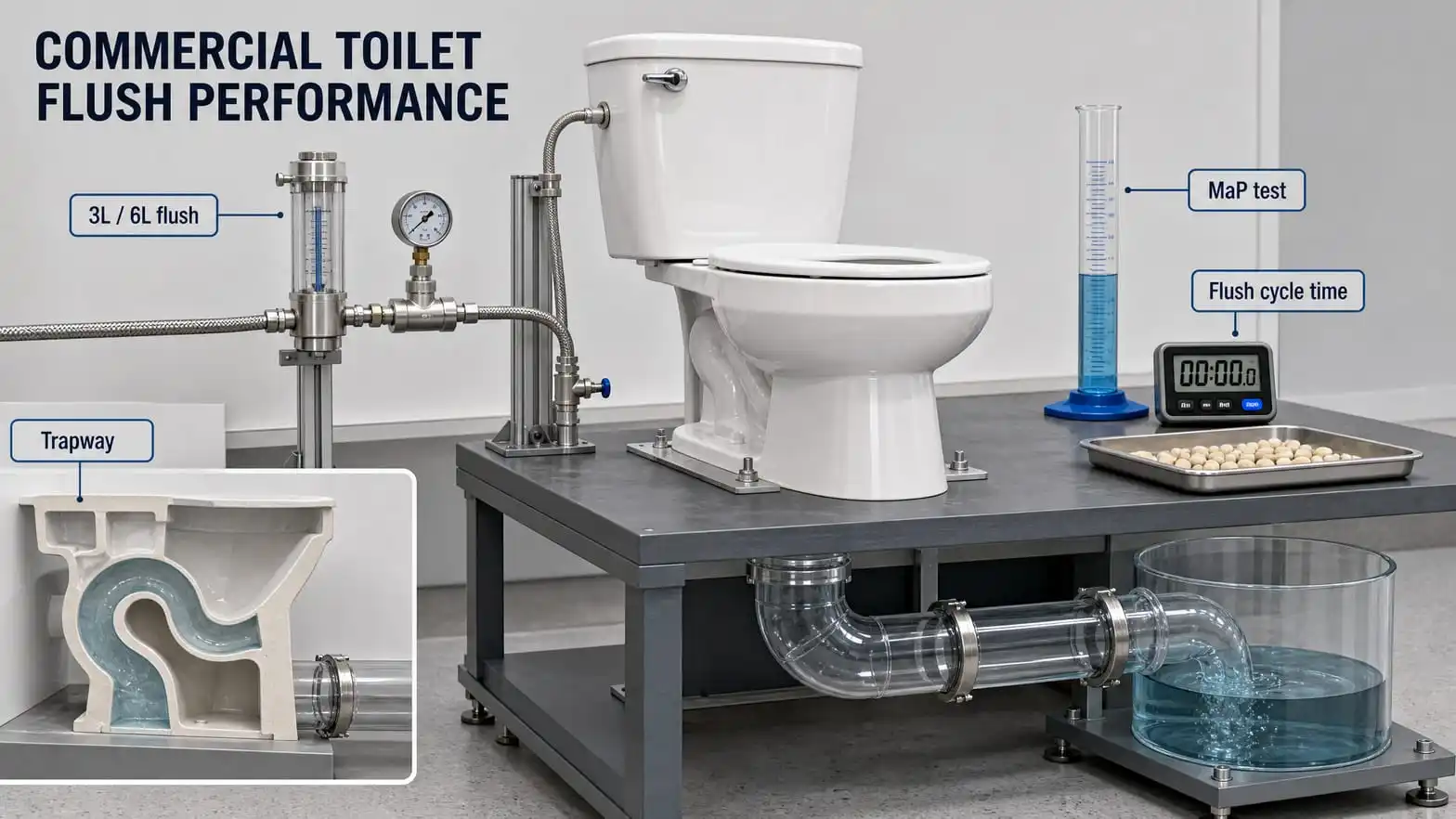
Flush performance is the fixture's ability to move waste from bowl to drain line reliably, on a predictable volume of water, without leaking or failing mechanically. Procurement teams should read a commercial toilet spec sheet as four numbers, not as adjectives:
| Number | What It Tells You | Where It Comes From | Commercial Benchmark |
|---|---|---|---|
| Trapway diameter | Clog resistance under real-world use | Physical measurement at the trapway restriction | ≥51mm (2") fully glazed, where applicable |
| Flush volume | Water cost per use, compliance status | Certified flush-function test | 3L reduced / 6L full dual flush (4.5L average) |
| MaP score | Waste evacuation capacity | Third-party MaP laboratory | 500g+ standard; 800–1000g for high-traffic venues |
| Certification marks | Legal access to the destination market | ASME / CSA / cUPC listing bodies | Set matched to the destination market |
The four numbers interact. A narrow trapway with a high flush volume can pass the MaP test and still clog in service, because real-world waste includes objects the MaP media does not simulate. A wide trapway with a weak flush leaves waste stranded on the rim. Flush performance is the combination of the four numbers - never any single one.
2. Trapway: The 51mm Rule - and Where It Applies
What the Trapway Does
The trapway is the internal passage between the bowl outlet and the drain connection. In a siphonic bowl - the dominant design in North America and most of Asia - the flush fills this curved passage, creates a siphon, and evacuates the bowl. Trapway geometry determines both siphon efficiency and clog resistance. A rough, unglazed trapway catches paper and debris; that is exactly why commercial specifications demand a fully glazed passage from rim to outlet.
The 51mm Benchmark
The widely cited commercial benchmark is a minimum 51mm (2-inch) trapway diameter maintained through the entire passage. Residential bowls commonly measure 44mm at the restriction. In a commercial restroom, the difference between 44mm and 51mm is the difference between a daily call-out for blockages and a fixture that survives a decade of foreign-object flushing. Facility specifications and MaP testing contexts both treat 51mm as the clog-resistance floor for high-traffic applications.
Where the 51mm Rule Does NOT Apply
The 51mm figure is not a universal dimensional law. It applies to gravity siphonic bowls with an integral trapway - "where applicable" means exactly that. Three common cases fall outside it:
- Washdown bowls (common in Europe): no internal trapway; the passage is shorter and steeper, and clog resistance is managed through flush design rather than trap geometry.
- Wall-hung bowls: they discharge into a concealed carrier and waste fitting; the trapway belongs to the carrier system, not to the bowl.
- Urinals and floor drains: governed by entirely different dimensional rules.
For bowls where the rule does apply, verify it physically: a caliper measurement at the trapway restriction, performed per the dimensional tolerance standards for ceramic sanitary ware, catches castings that "look right" but fall short of spec. Trapway quality is decided at the casting and glazing stages of the vitreous china toilet manufacturing process - no final-assembly step can fix a rough passage.
3. Flush Volume: The 3L/6L Dual-Flush Configuration and Regional Limits
The most common dual-flush specification on commercially exported gravity toilets is 3L reduced / 6L full: 3 litres for liquid waste, 6 litres for solid waste. Averaged across a typical 50/50 use split, a 3/6L fixture consumes 4.5 litres per flush - approximately 1.19 gallons. That single figure is why 3/6L dual flush has become the default export configuration: it clears solid waste reliably and still lands under most efficiency thresholds.
But 3/6L is a fixture configuration, not a universal code limit. Different markets cap flush volume differently, and the fixture must be configured, tested, and certified against the limits of the destination market:
| Market | Governing Requirement | Maximum Effective Volume | Notes |
|---|---|---|---|
| United States (federal) | EPAct 1992 | 6.0L (1.6 gpf) | Applies to every toilet sold in the US |
| United States (WaterSense) | EPA WaterSense specification | 4.8L (1.28 gpf) average | Voluntary but near-mandatory for commercial projects; dual-flush volume averaged 50/50 |
| Canada | CSA B45.1 and provincial plumbing codes | 6.0L (1.6 gpf) | Confirm provincial adoption |
| European Union | EN 997 | 6.0L full flush (Class 1) | Washdown bowl geometry common |
A 3/6L fixture (4.5L average ≈ 1.19 gpf) satisfies the US WaterSense 1.28 gpf threshold, the US federal 1.6 gpf maximum, and the 6.0L ceilings in Canada and the EU - but only when the fixture is actually set to those volumes at the factory and verified in the certification test. A "3/6L" label on a fixture whose full flush discharges 6.5L is a compliance failure waiting for a utility audit. Ask for the certified flush-function test report, not the sticker.
4. MaP Testing: How Waste Evacuation Is Measured
MaP - Maximum Performance - is the most widely used flush performance rating in North America. Developed by Veritec Consulting in cooperation with the Canadian Water and Wastewater Association, MaP measures how much synthetic waste a toilet can evacuate completely. It is a third-party rating tool, not a code requirement and not a certification.
The Media and the Protocol
- Test media: sealed sleeves filled with soybean paste - a standardized synthetic waste with consistent density and shear behaviour, dosed in 250g units.
- Protocol: media is added in 250g increments. At each dose level the fixture must evacuate 100% of the load on every flush trial before advancing to the next increment.
- Score: the MaP score is the highest dose, in grams, at which the fixture achieves complete clearance - 350g, 500g, 800g, 1000g and above.
- Lab conditions: the fixture is installed exactly per the manufacturer's instructions on a test rig with a measured drain slope; every flush is collected and weighed.
Commercial facility specifications commonly require MaP 500g or higher; high-traffic venues - airports, stadiums, transit hubs - increasingly ask for 800–1000g. The MaP score does not predict clogging from non-standard objects such as paper towels or packaging; that is the trapway's job. Treat MaP as the evacuation benchmark and the 51mm trapway as the clog-resistance benchmark - they are complementary, not interchangeable.
| MaP Score | Typical Application | What It Means in Service |
|---|---|---|
| 350g | Entry-level residential | Clears normal loads; marginal under heavy use |
| 500g | Light commercial | Standard commercial minimum in many specifications |
| 800g | Commercial / institutional | Confident under sustained high traffic |
| 1000g+ | High-traffic venues | Highest evacuation capacity class |
Verify that the report comes from an accredited MaP testing laboratory and documents the exact model, flush volume, and media batch. A MaP claim without a report is a marketing phrase.
5. Certification Landscape: ASME A112.19.2, CSA B45.1, and cUPC - Scope Matters
Certification is where scope errors get expensive. The three marks most commonly requested on commercial toilet RFQs - ASME A112.19.2, CSA B45.1, and cUPC - are related but not interchangeable, and none of them is a worldwide passport.
The Harmonized Bi-National Standard
ASME A112.19.2 and CSA B45.1 are jointly maintained as a harmonized bi-national standard for ceramic plumbing fixtures, in force in both the United States and Canada. It sets the enforceable baseline: water consumption limits, flush-function performance using standardized test media, structural integrity (including load tests on bowl and tank), and material properties. For vitreous china, the standard caps water absorption at 0.5% when tested per ASTM C373 - the property that keeps a commercial fixture from soaking up moisture, odour, and stain over decades of service. Most export-grade commercial bodies comfortably beat the 0.5% ceiling; the certification test is what proves it.
cUPC vs UPC: Two Marks, Two Markets
cUPC is the certification mark for the Canadian market, administered by IAPMO R&T against the Canadian Uniform Plumbing Code and the applicable CSA/ASME standards. UPC is its US counterpart, for US jurisdictions that adopt the Uniform Plumbing Code. Neither mark is a substitute for the other:
| Mark / Standard | Scope | What It Covers | What It Does NOT Cover |
|---|---|---|---|
| ASME A112.19.2 / CSA B45.1 | US + Canada | The ceramic-fixture standard itself: water consumption, flush function, structural integrity, ≤0.5% water absorption | By itself, grants no certification mark or market listing |
| cUPC (IAPMO R&T) | Canada | Product listing for the Canadian market under the Canadian Uniform Plumbing Code | US jurisdictions (require a US listing such as UPC) |
| UPC (IAPMO R&T) | US states adopting the Uniform Plumbing Code | Product listing for those jurisdictions | Canada, and US states adopting the International Plumbing Code (IPC) |
For states that adopt the International Plumbing Code - the other major US code family - acceptance criteria differ again. That is exactly why the first question for any supplier should be: which market, and which code does that market adopt?
📌 The procurement rule: match the certification set to the destination market. A cUPC-only fixture has no standing in a US project; an ASME-standard-compliant fixture with no listing fails a Canadian inspection. Request certification certificates per market, and verify each mark number on the certifying body's public registry.
Water Absorption ≤0.5% in the QC Chain
The 0.5% water absorption ceiling connects certification back to the factory. Absorption is measured on fired body samples per ASTM C373 (boiled-water method), and a compliant factory tests it at defined intervals - not once per product launch. The complete QC testing protocol for ceramic sanitary ware covers where water absorption, leak, and flush-function checks sit in the inspection sequence, and the dimensional tolerance guide covers how trapway and rough-in measurements are verified against the certified drawing.
6. Factory QC Gates: Test Media, Leak, Overflow, and Flush Valve
Certification proves a production sample. Factory QC proves the shipment. Four gates matter most for flush performance:
- Flush test media: the production-line flush-function test uses the same synthetic-media family as the certification test - soybean-paste media dosed at the rated flush volume, plus auxiliary tissue and granule media for transport and ball-clearance attributes. A factory that skips media-based testing and runs only "water-only" flushes is not testing flush performance at all.
- Leak test: the assembled bowl and tank are filled and held under hydrostatic pressure; any seepage through the body, glaze pinholes, or the tank-to-bowl interface fails the unit. The trap seal is verified at a minimum 50mm - below that, sewer gas enters the room and the fixture fails inspection.
- Overflow test: with the tank filling and the flush valve blocked, the overflow tube must carry water to the bowl without leaking past the tank lid or valve seat - the failure mode behind "my tank overflows onto the floor" complaints.
- Flush valve endurance: the fill/flush valve assembly is cycled continuously; commercial-grade mechanisms are verified to 250,000+ cycles at roughly 60-second intervals, with flush volume held within ±10% of the rated value after the test. Valve failure is the number-one cause of premature commercial toilet replacement - the cycle report is the antidote.
- Water absorption: fired-body samples from the same batch are tested per ASTM C373 against the ≤0.5% ceiling, and results are logged per kiln load, not per order.
None of these gates can fix a trapway that was poorly formed at the casting stage or a glaze that was underfired. That is why flush performance starts upstream in the vitreous china toilet manufacturing process - casting, glazing, and firing determine the trapway surface quality and body density that QC then verifies.
The Procurement Checklist
Before issuing a purchase order for commercial toilets, a buyer should be able to tick five boxes:
- Trapway ≥51mm verified by physical measurement - where the bowl design has an integral trapway.
- Flush volume configured and certified for the destination market - 3L/6L dual flush where allowed, with the certified flush-function report at hand.
- MaP score of 500g or higher from an accredited laboratory, documented per model.
- Certification set matched to the market - ASME A112.19.2/CSA B45.1 compliance plus the correct listing (cUPC for Canada, an appropriate US listing for the US), verified on the certifying body's registry.
- Water absorption ≤0.5% (ASTM C373) with batch-level records, plus leak, overflow, and 250,000-cycle flush valve reports.
Flush performance is the most visible quality a commercial toilet has: it is tested dozens of times a day, every day, by every user. The fixtures that survive high-traffic service are not the ones with the best marketing copy - they are the ones whose trapway, flush volume, MaP score, and certification set were specified, measured, and verified before the container shipped.
Frequently Asked Questions
What is a MaP score and what should a commercial toilet score?
MaP (Maximum Performance) measures how much synthetic soybean-paste waste a toilet evacuates completely, tested in 250g increments by an accredited third-party laboratory. Commercial specifications typically require a MaP score of 500g or higher; high-traffic venues such as airports and stadiums often specify 800–1000g.
Is a 3L/6L dual-flush toilet compliant in the United States?
Yes, when configured and certified correctly. A 3L/6L dual-flush fixture averages 4.5 litres per flush (≈1.19 gpf), below the US federal 1.6 gpf maximum (EPAct 1992) and the EPA WaterSense 1.28 gpf effective average. Compliance requires the certified flush-function test report documenting the actual rated volumes.
What is the difference between UPC and cUPC certification?
cUPC is IAPMO R&T's product certification for the Canadian market, based on the Canadian Uniform Plumbing Code and applicable CSA/ASME standards. UPC is the US counterpart for states adopting the Uniform Plumbing Code. Neither mark covers the other market, and US states adopting the International Plumbing Code (IPC) use a different listing framework.
Does ASME A112.19.2 apply in Canada?
ASME A112.19.2 and CSA B45.1 are maintained as a single harmonized bi-national standard for ceramic plumbing fixtures covering both the United States and Canada. For actual Canadian market access, a fixture additionally needs the cUPC listing (or an equivalent Canadian certification).
What trapway size should a commercial toilet have?
For siphonic gravity bowls with an integral trapway, commercial specifications call for a minimum 51mm (2-inch) fully glazed passage, compared with roughly 44mm on many residential bowls. The 51mm rule applies where a bowl-integral trapway exists; washdown bowls, wall-hung carrier systems, and urinals follow different dimensional rules.
What is the maximum water absorption for certified vitreous china?
ASME A112.19.2/CSA B45.1 caps water absorption at 0.5% for vitreous china when tested per ASTM C373 (boiled-water method). A compliant factory tests fired-body samples at defined intervals and logs results per kiln load, not per order.
🛡️ Get Flush Performance Test Documentation
Procuring commercial toilets or bathroom fixtures? Contact Yingjie Bath for MaP test reports, ASME/CSA/cUPC certificates, and batch-level QC records.
👉 Request Flush Performance Test Reports & Commercial Quote