
The surface finish of a ceramic washbasin is the most visible specification decision in a commercial bathroom project - and the one least supported by test data. Buyers compare price, dimensions, and lead time, yet the finish determines how the basin looks on installation day, how it looks in year five, and how much cleaning labor it consumes every single day in between.
Choosing between a matte and a gloss ceramic basin is not a styling preference. It is a materials decision with measurable consequences for maintenance cost, color consistency, and service life.
1. Glaze Composition: The Physical Difference Between Matte and Gloss
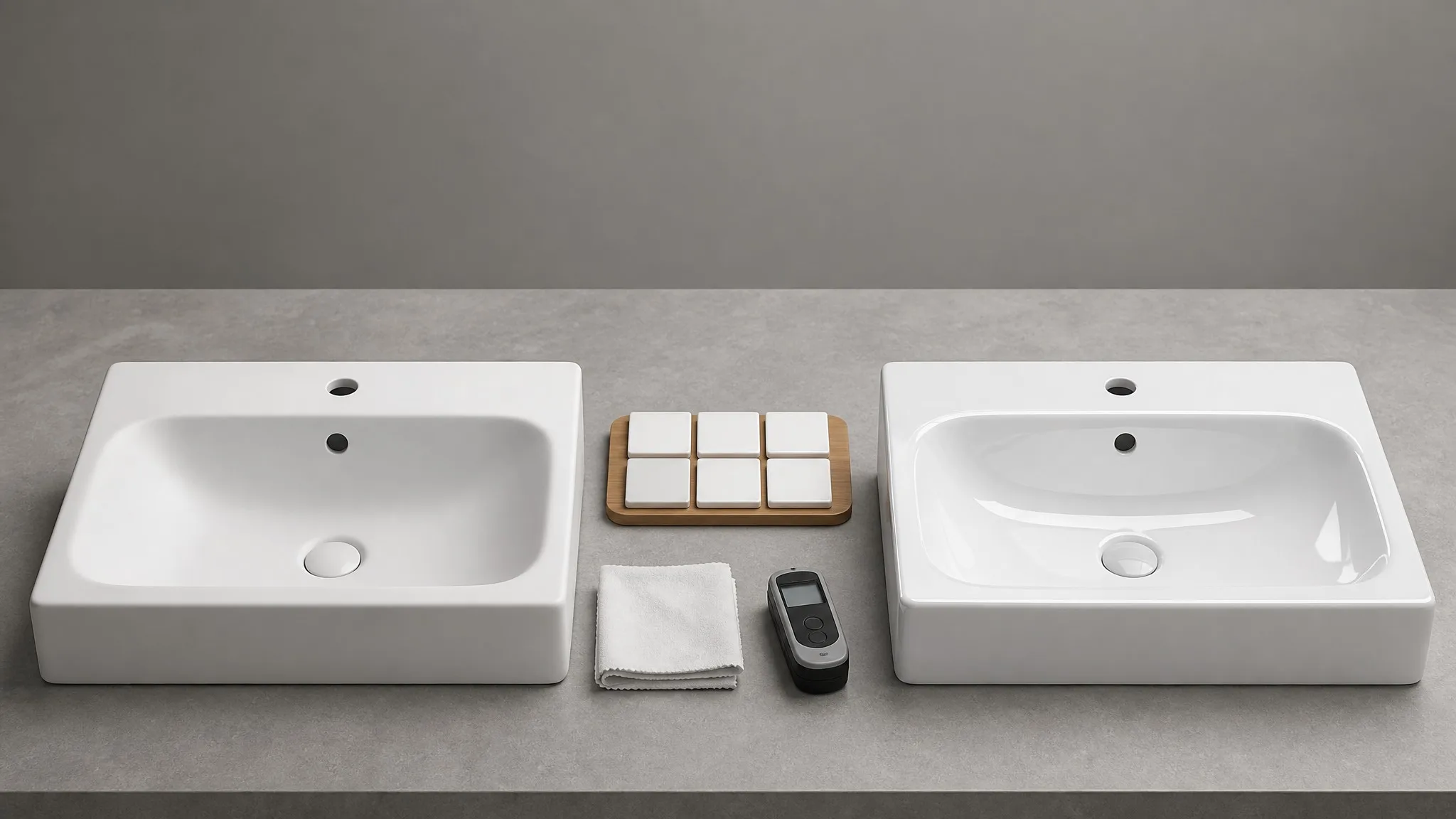
Both finishes are fired ceramic glazes - the difference is flux chemistry and the crystalline microstructure of the fired surface. A gloss finish is a high-flux glaze: feldspar with zinc and alkaline-earth fluxes melts into a continuous, smooth glassy layer during glaze firing at roughly 1180–1250°C. The fired surface is smooth at the microscopic level and reflects light specularly. Measured with a 60° gloss meter (ISO 2813 geometry), a production gloss sanitary glaze typically reads 70–90 gloss units (GU).
A matte finish uses the same glass base but adds matting agents - zinc oxide, barium carbonate, or titanium dioxide - that promote controlled devitrification during the cooling phase of the kiln. Microscopic crystals form inside the glass matrix, and the fired surface scatters reflected light instead of mirroring it. Production matte sanitary glazes typically read 5–20 GU.
Glaze Thickness: The 0.8–1.2mm Commercial Specification
The commercial specification for either finish is 0.8–1.2mm of applied glaze thickness. In practice, gloss finishes are run at the lower end of the range (0.8–1.0mm), while matte finishes are specified at the higher end (1.0–1.2mm): the devitrified, micro-textured matte layer needs a slightly thicker glass barrier to remain continuous and impermeable. Glaze thickness is verified with a glaze thickness gauge or by fired cross-section measurement - the complete measurement and acceptance protocol is documented in our ceramic sanitary ware quality control testing guide.
Thickness is the single best predictor of surface performance. A basin with 0.5–0.6mm of glaze fails the commercial cleaning regime within 18–24 months, regardless of finish - the glaze erodes to the body, and the exposed ceramic stains permanently.
2. Cleaning Behavior and Stain Resistance
Both finishes from a quality supplier pass ISO 10545-14 stain-resistance testing at class 4–5 (no visible residue after standard cleaning). The real difference between matte and gloss is not whether they stain - it is how visibly they soil, how hard they are to clean, and how the surface reacts to cleaning chemicals.
- Gloss behavior: Water spots, soap scum, fingerprints, and smears are immediately visible on a mirror surface - gloss basins in public washrooms look dirty by mid-morning. The compensating advantage: the smooth surface releases residue easily, and a daily pH-neutral wipe restores a perfect finish. The weakness is visible damage - hard water scale etches visibly, and micro-scratches from abrasive pads accumulate into a permanent dull haze under raking light.
- Matte behavior: A matte surface hides water spots, fingerprints, and smears, so the basin presents a uniform, clean appearance between cleanings - the dominant reason architects specify matte for high-traffic washrooms. The trade-off: the micro-rough surface holds dried residue at the microscopic level, so contaminants left to dry require more effort to remove. Abrasive scouring pads are strictly forbidden - they locally flatten the matte texture and leave permanent shiny burnished patches.
Chemical Resistance
Under ISO 10545-13 chemical-resistance testing (household chemicals classes UA–UC), both finishes withstand pH-neutral cleaners and mildly acidic or basic formulations. The observable difference is in failure detection: gloss surfaces reveal chemical attack immediately as dull, etched patches; matte surfaces hide minor attack but develop a sheen change in the affected zone over repeated exposure. In both cases, bleach concentrates and undiluted acid descaling chemicals are the common culprits.
Cleaning Protocol for Commercial Operation
| Task | Frequency | Recommended Agent | Matte Finish | Gloss Finish |
|---|---|---|---|---|
| Daily wipe-down | 1×/day (high traffic: 2–3×) | pH-neutral cleaner, diluted per label | Soft microfiber cloth | Soft microfiber cloth |
| Weekly deep clean | 1×/week | Non-abrasive cream cleanser | Soft sponge, rinse fully | Soft sponge, rinse fully |
| Scale removal | As needed | Short-contact citric-based descaler (≤5 min) | Rinse thoroughly, dry | Rinse thoroughly, dry |
| Never use | - | Scouring pads, steel wool, bleach concentrate, undiluted acid | Burnishes shiny patches into matte surface | Etches and dulls gloss surface |
3. Color Retention: Delta E Control and D65 Lighting
Color control on sanitary ware is performed with a spectrophotometer under the D65 illuminant (6500K average daylight), using the 10° observer (CIE 1964 standard observer), and reported as CIEDE2000 color difference (ΔE00). Acceptance thresholds used in commercial basin programs:
| Measurement | Acceptance Threshold |
|---|---|
| Within a single production batch | ΔE00 ≤ 1.0 (premium programs: ≤0.5) |
| Between production batches on a running project | ΔE00 ≤ 2.0 |
| Gloss finish readings | Specular component included (SCI) |
| Matte finish readings | Specular component excluded (SCE) |
The specular component rule matters because gloss dominates measured color. A gloss surface reflects the light source directly into the instrument, inflating lightness readings; a matte surface scatters it. Comparing a gloss reading taken SCI against a matte reading taken SCE is meaningless - the supplier's Delta E report must state the instrument geometry for each finish. When a project mixes matte and gloss basins, insist on one instrument protocol and a single reference standard for both.
Color Retention Over Service Life
Ceramic pigments and zircon-based opacifiers mature at 1200°C+ during firing, so the fired color of the glaze does not fade under UV exposure - a basin that is white on day one remains white in the body. What changes in service is the surface. Gloss finishes accumulate fine micro-scratches that lower gloss units and shift perceived color toward a milky, desaturated tone; matte finishes hold their perceived color because a change within the 5–20 GU range is imperceptible to the eye.
Matte color is harder to produce consistently: matting agents and opacifiers interact during devitrification, and slight kiln variations show up as sheen variation or orange-peel rather than a clean hue shift. Color variation, orange peel, and pinhole defects on matte surfaces are common glaze defects - their root causes and detection methods are covered in our glaze defect detection guide.
4. Water Absorption and Body Specification
Finish performance depends on the ceramic body underneath it. The commercial basin specification is water absorption ≤0.5%, tested by the 24-hour boiling method (ISO 10545-3); premium vitreous china programs run at ≤0.2%. A porous body wicks moisture to the glaze interface and is the root cause of crazing and glaze delamination - on matte finishes this appears as slowly darkening patches, on gloss as a fine crack network that fills with soap scum. Both finishes fail identically on a bad body; the finish only changes how the failure looks. The full raw-material-to-shipment test battery, including water absorption and crazing testing, is documented in our quality control testing protocol article.
5. Commercial Restroom Specification: Decision Framework
There is no universally correct finish - there is a correct finish per project type. The decision framework used by commercial specifiers:
| Project Type | Operating Priority | Recommended Finish | Rationale |
|---|---|---|---|
| High-traffic public restroom (transit, stadium, mall) | Low cleaning labor, uniform appearance | Matte | Hides water spots, smears, and wear; no specular hotspots; appearance stays uniform between cleanings |
| Hospitality / design-led hotel bathroom | Premium visual depth, dedicated housekeeping | Gloss | Deeper color saturation, mirror reflections, richer perceived quality; daily professional cleaning is already budgeted |
| Healthcare / hygiene-critical facility | Perceived hygiene, glare control, disinfectant compatibility | Matte | Diffuses light and hides smears; verify disinfectant compatibility (ISO 10545-13) for the specific chemicals before specifying |
| Corporate office washroom | Balanced cost and maintenance | Matte (or mixed) | Matte carries most of the labor savings; if mixing finishes, enforce Delta E and dimensional consistency across the set |
Two service-level rules apply regardless of finish. First, lighting: gloss basins under linear downlights create specular hotspots and mirror glare at face height, while matte diffuses the light evenly - review the luminaire layout before finalizing the finish. Second, set consistency: commercial washrooms install 2–8 basins per room, and identical appearance across the set requires both color consistency (ΔE00 ≤ 1.0) and dimensional consistency. Ceramic shrinkage makes dimensional tolerance the hardest spec to hold - measurement practice and tolerance standards are covered in our dimensional tolerance guide for ceramic sanitary ware.
6. Procurement Checklist: What to Demand from the Supplier
Add these five requirements to the RFQ when specifying ceramic basins, whichever finish you choose:
2. Water absorption: ≤0.5% by ISO 10545-3 (≤0.2% for premium programs), with test documentation.
3. Delta E report: within-batch ≤1.0 and batch-to-batch ≤2.0 under D65, stating SCI/SCE geometry per finish.
4. Surface testing: ISO 10545-14 stain resistance class 4+ and ISO 10545-13 chemical resistance for the facility's cleaning chemicals.
5. Fired samples: matte and gloss samples fired from the same production batch as the order, to verify color and sheen before mass production.
The finish decision is reversible at the specification stage and expensive after installation. Glaze thickness, water absorption, Delta E, and surface test data convert a styling preference into a verifiable specification - and they are the same data points that protect you in the claims process if a batch arrives off-color or stains in service.
Frequently Asked Questions
Which is easier to keep clean: a matte or gloss ceramic basin?
Matte finishes hide water spots, fingerprints, and smears, so they present a uniform appearance between cleanings and require less frequent visible cleaning - the main reason they are specified for high-traffic commercial washrooms. Gloss finishes show soiling immediately but release residue more easily with a pH-neutral cleaner. Both require the same daily protocol: pH-neutral cleaner with a soft microfiber cloth. Abrasive pads are forbidden on both - they burnish shiny patches into matte surfaces and etch dull haze into gloss.
Does a matte ceramic basin stain more easily than a gloss basin?
With a quality glaze at commercial thickness (1.0–1.2mm for matte), both finishes pass ISO 10545-14 stain-resistance testing at class 4–5. The practical difference is cleaning effort: the micro-rough matte surface can hold dried residue at the microscopic level, so contaminants left to dry require prompt removal, while gloss releases residue easily but shows every smear immediately. Stain permanence is driven by body quality - water absorption must be ≤0.5% (ISO 10545-3) to prevent sub-surface staining in either finish.
What does Delta E mean when specifying ceramic basin color?
Delta E (CIEDE2000, ΔE00) quantifies the color difference between two samples measured by spectrophotometer under D65 illuminant (6500K) with the 10° observer. Commercial basin programs accept ΔE00 ≤ 1.0 within a batch and ≤ 2.0 between batches. Instrument geometry matters: gloss readings use specular component included (SCI), matte readings specular component excluded (SCE). When a project mixes finishes, both must be measured under one instrument protocol and one reference standard.
What glaze thickness should a commercial ceramic basin specification require?
The commercial specification is 0.8–1.2mm of applied glaze thickness: 0.8–1.0mm for gloss finishes and 1.0–1.2mm for matte finishes, because the devitrified matte layer needs a slightly thicker glass barrier to stay continuous and impermeable. Below 0.6mm, glaze erodes under commercial cleaning within 18–24 months and the exposed body stains permanently. Thickness is verified with a glaze thickness gauge or fired cross-section, and the QC report should be requested at RFQ stage.
Should I specify matte or gloss basins for a commercial restroom?
It depends on the operating model. High-traffic public restrooms (transit, stadium, mall) should specify matte: it hides water spots, smears, and wear, and stays uniform between cleanings. Hospitality projects with daily professional housekeeping can specify gloss for deeper color saturation and perceived quality. Healthcare facilities typically choose matte for glare control and smear hiding. Corporate washrooms default to matte, optionally mixing finishes with strict Delta E and dimensional consistency requirements across the set.
🧽 Get Matte & Gloss Basin Samples and Test Reports
Selecting ceramic basins for a commercial project? Contact Yingjie Bath for matte/gloss glaze samples, Delta E color reports, and bulk commercial quotes.
👉 Request Matte & Gloss Basin Samples & Test Reports