
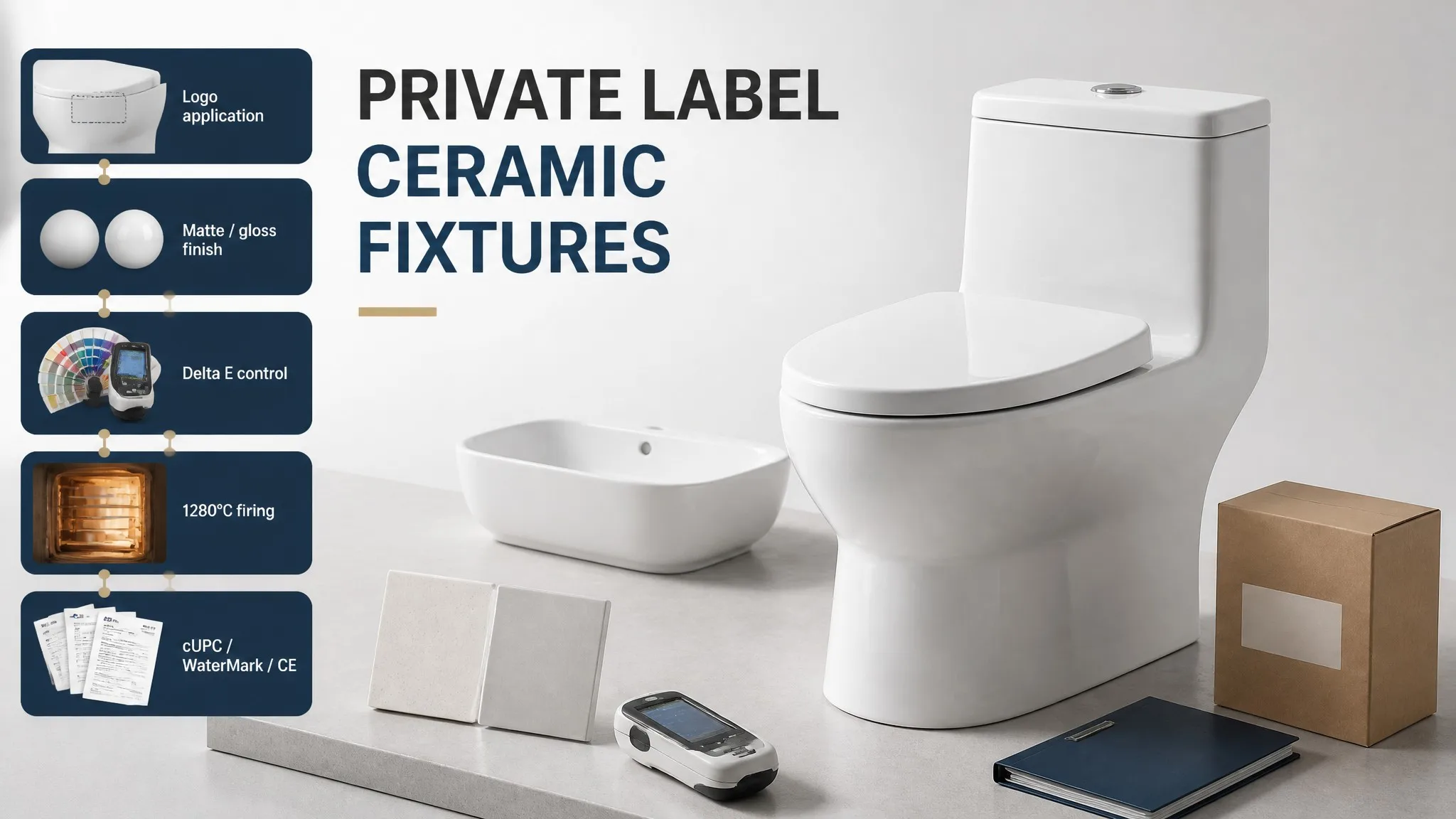
Private label is the contract under which the buyer supplies the brand and the factory supplies everything else - the body, the glaze, the packaging, the paperwork, and the quality control that protects the brand once it is on the product.
In ceramic sanitary ware, that contract has five workstreams: logo application, surface finish, packaging, compliance documentation, and the sample approval chain. Each has measurable acceptance criteria, and each fails in a predictable way when those criteria are left out of the purchase order.
1. Logo Application: Five Methods with Different Durability Profiles
The logo on a ceramic fixture is not a sticker. It is a decoration that is fired into or onto the glaze, and the method chosen determines how long the logo survives cleaning chemicals, scratching, and daily use. Five methods are used in commercial production:
| Method | Process | Firing | Logo position | Durability | Cost / unit |
|---|---|---|---|---|---|
| Underglaze decal | Ceramic pigments applied to bisque body | 1280°C single fire | Inside the glaze layer | 1 - longest | +$1.20–2.50 |
| Overglaze decal | Decal applied on fired glaze, refired | 750–850°C second fire | On the glaze surface | 2 | +$0.80–1.80 |
| Pad printing | Silicone pad transfers ink onto fired glaze | No refire | On the glaze surface | 3 | +$0.40–1.00 |
| Mold embossing | Logo built into plaster mold as relief | 1280°C single fire | In the body surface | 1 - permanent, monochrome | +$300–800 mold charge |
| Laser etching | Glaze layer ablated on the fired piece | Post-fire | Into the glaze | 3–4 | +$1.50–3.00 |
Underglaze decal is the standard choice for brands that plan to stay in the market for years. The decal is applied to the bisque-fired body, covered by the glaze, and fired at 1280°C. The logo ends up inside the glaze layer: it cannot be scratched off, and cleaning chemicals contact the glaze rather than the pigment. The trade-off is color - ceramic pigments shift during firing, so the fired color never matches the printed proof exactly. That shift must be approved on a fired sample, not on a paper proof.
Overglaze decal and pad printing cost less and reproduce color more predictably, but the decoration sits on the surface. On high-touch areas (tank fronts, basin rims), these methods show visible wear within 2–4 years in commercial environments.
Mold embossing produces a logo that is physically part of the body and cannot wear off, but it is monochrome and permanent, and it locks the buyer to a dedicated mold - which raises the mold MOQ. Laser etching removes a thin glaze layer to create a subtle tonal mark; it suits matte finishes where a low-contrast logo is preferred.
Artwork requirements are the same regardless of method: vector outlines (AI or PDF with outlined text), Pantone or RAL color references, and a maximum printable area per surface. The factory should deliver a fired strike-off sample before production - a paper print proof is not an approval.
2. Finish Specification: Matte vs. Gloss Glaze, Thickness, and Color Tolerance
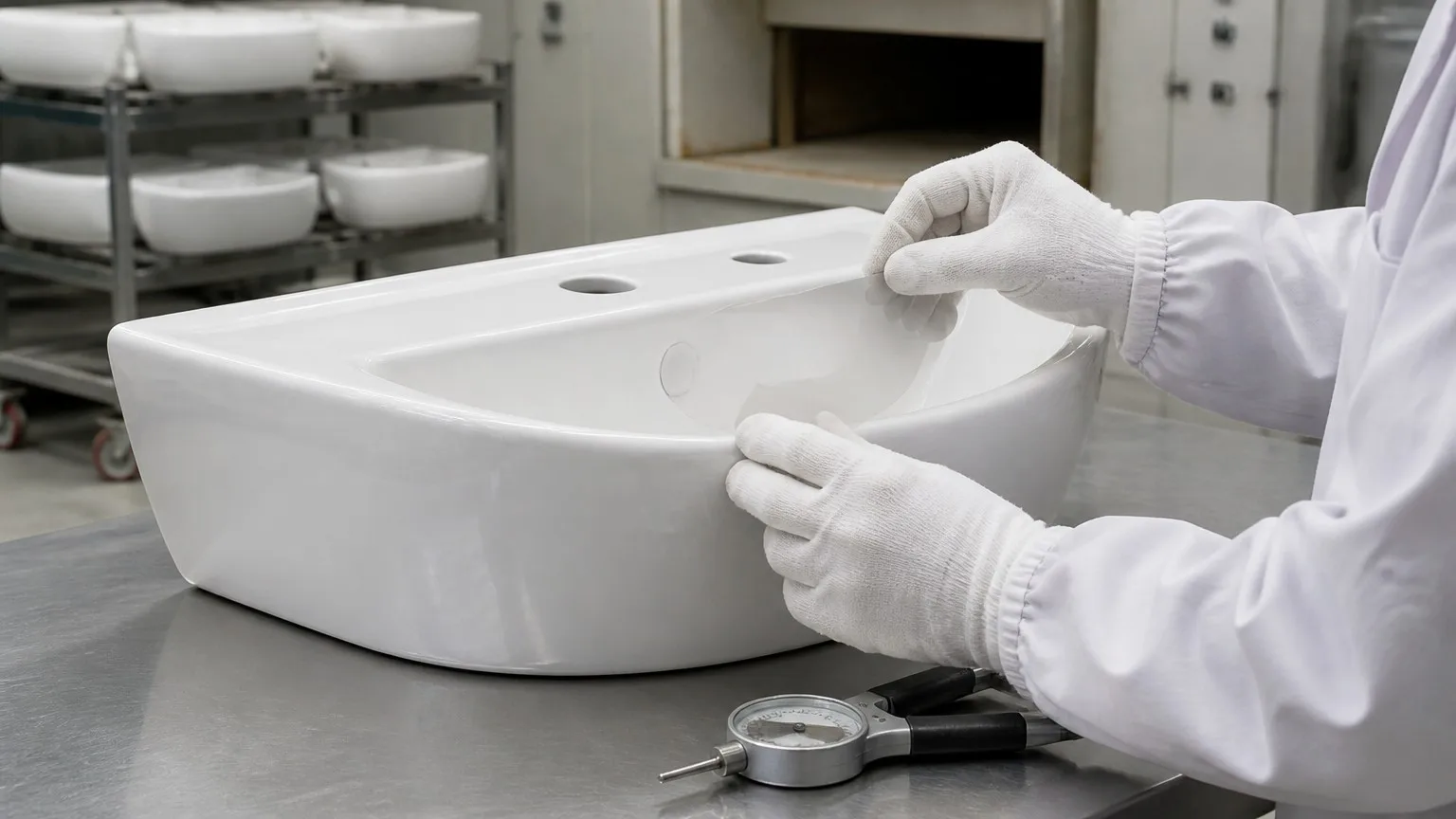
Finish is the first thing a customer sees and the first thing a buyer argues about. Commercial production uses two glaze families, and the specification must be written in numbers, not adjectives.
Gloss glaze - 85–95 GU measured on a 60° glossmeter (ISO 2813). A smooth, fully closed gloss surface releases stains and is the default for residential and light commercial lines.
Matte glaze - 10–30 GU at 60°. Matte finishes hide water spotting and fingerprints, which is why they dominate hospitality design. The production cost is not lower: matte surfaces expose application defects (pinholes, runs, glaze pulls) that a gloss surface conceals, and matte glazes are slightly more porous at the surface, so stain-release performance must be verified with the same test protocol used for gloss.
Regardless of family, a private label contract should fix four numbers:
Glaze thickness: 1.0–1.2mm
Over all visible surfaces, measured by cross-section under magnification or by nondestructive coating gauge on fired samples. Below 0.8mm, the glaze wears through within 3–5 years in commercial service.
Firing at 1280°C
The body vitrifies to ≤0.2% water absorption and the glaze fully matures in the same kiln cycle. Firing temperature is not negotiable per batch - the vitreous china toilet manufacturing process article explains how tunnel kiln profiles hold that temperature across thousands of pieces per day.
Glaze–body fit
A thermal expansion mismatch between glaze and body produces crazing - hairline cracks in the glaze that appear within weeks of installation. The full failure catalog, detection methods, and prevention controls are documented in the glaze defect analysis guide.
Delta E (ΔE) color tolerance
ΔE is the CIELAB color difference between a measured sample and a reference. Enforceable values: ΔE ≤ 1.5 against the approved golden sample within a production run, ΔE ≤ 2.0 between runs. Measurement: spectrophotometer, D65 illuminant, 10° observer, average of three readings at defined points.
Ceramic color drifts for physical reasons: pigment batch variation, glaze slip density, kiln position (top versus bottom shelf differs by 10–20°C), and wall thickness. A supplier that quotes "same color as last time" without ΔE data has no color control program. A supplier that delivers a ΔE report with each batch has one.
Finish Specification Summary
| Parameter | Gloss spec | Matte spec | Test method |
|---|---|---|---|
| 60° gloss reading | 85–95 GU | 10–30 GU | ISO 2813 glossmeter |
| Glaze thickness | 1.0–1.2mm | 1.0–1.2mm | Cross-section / coating gauge |
| Color vs. golden sample | ΔE ≤ 1.5 | ΔE ≤ 1.5 | CIELAB, D65, 10° |
| Between-run color | ΔE ≤ 2.0 | ΔE ≤ 2.0 | CIELAB, D65, 10° |
| Firing temperature | 1280°C | 1280°C | Kiln profile records |
3. Packaging: Cartons, Labels, and Marking Verification
The carton is the first piece of brand collateral the customer touches, and the label is the document that moves the goods through customs. Export damage control - double-wall cartons with an Edge Crush Test rating of 9.0 kN/m, foam corner blocks, PE film, and stuffing rules - is the subject of the export packaging standards article. Private label adds two requirements on top: printed cartons and verified labels.
Printed cartons. Private label cartons carry the buyer's brand, product name, model, and often a product photo. The factory orders these from a box maker; the printing plate is a one-time cost of roughly $150–400 per carton design, and the carton MOQ typically runs 500–1,000 pieces per design. The carton proof must be approved before the box maker starts the run - the same approval gate logic as the logo strike-off.
Label Fields
| Field | Required content | Why it matters |
|---|---|---|
| Brand and model | Buyer's brand name, model code | Shelf and catalog matching |
| Barcode | UPC/EAN-13, ANSI print grade C or better | Retail scanning reliability |
| HS code | 6910.10 (porcelain/china sanitary ware) | Customs classification |
| Quantities | Pieces per carton, cartons per pallet, total | Count verification |
| Weights | Net and gross weight per carton | Freight pricing, handling safety |
| Dimensions | Carton L×W×H | Container planning |
| Origin marking | "Made in China" | Labeling law compliance |
| Handling marks | Fragile, this side up | Transit care |
Container density planning - how carton dimensions translate into 20ft and 40ft loading plans - is covered in the container loading guide. Labels are verified with a barcode verifier at final inspection; a label that scans at grade D on the dock is a chargeback at retail. The label proof (fields, dimensions, barcode) goes through the same approval gate as the carton proof.
4. Compliance Documentation: cUPC, WaterMark, and CE Files
A fixture that passes factory QC but fails market certification is a recall. The compliance file set differs by destination market, and the buyer should request the files by name in the purchase order:
cUPC (North America)
Certification against the Uniform Plumbing Code (IAPMO), with the "c" prefix indicating Canadian code recognition (CSA B45 series) and flush performance per ASME A112.19.2 - 6.0 L maximum water consumption. File set: active certificate covering the exact model number, the third-party test report, and the certification label artwork. Certificates are model-specific, not company-wide - verify the model number on the certificate matches the purchase order.
WaterMark (Australia)
Mandatory for plumbing products sold and installed in Australia. Certification is issued against the AS/NZS 5200 series; dual-flush fixtures must also carry WELS registration (commonly 4.5/3 L). File set: WaterMark certificate, WELS registration number, test evidence. Without WaterMark, the fixture cannot be legally installed in Australia - this is a non-negotiable document, not a marketing certificate.
CE (European Union)
Bare ceramic sanitary ware is not subject to a CE marking requirement, but the moment a fixture carries an electronic component - electronic flush actuators, sensor faucets, smart mirrors, heated seats - the Low Voltage Directive (2014/35/EU) and EMC Directive (2014/30/EU) apply. Many EU distributors request a Declaration of Conformity and the supporting test file for the assembled product even when the ceramic body alone is exempt.
Certification timing is a planning constraint: initial certification programs consume 4–8 weeks including sample preparation and third-party testing, and certificates are re-audited on a cycle. The Incoterms guide covers where the compliance and customs burden sits under FOB, CIF, and DDP - under DDP, the supplier clears the goods, so certificate validity becomes the supplier's problem to prove.
5. MOQ and the Approval Workflow: From First Sample to Golden Sample
MOQ structure. Private label MOQs are quoted at three levels, and each level is driven by a different cost:
| MOQ level | Typical range | Driver |
|---|---|---|
| Body / shape program | 500–1,000 units per year | Mold amortization and kiln scheduling |
| Decoration (logo / color) | 100–300 units per SKU | Decal, pigment, and color-change firing costs |
| Printed cartons | 500–1,000 cartons per design | Box maker plate and run minimums |
A 150-unit order with four decoration options prices differently from one 600-unit order with a single logo - the per-unit gap is typically 8–15%, driven almost entirely by setup and color-change firing costs. Whether the factory can actually commit to your MOQ on your timeline depends on mold inventory and kiln capacity; the production capacity assessment guide provides the calculation framework.
The approval chain. Every private label order runs through five approval gates:
| Gate | Deliverable | Sign-off basis |
|---|---|---|
| 1. Artwork | Logo / decoration strike-off, fired | Fired sample vs. artwork reference |
| 2. Pre-production sample (PPS) | Full fixture from the production process | Visual and dimensional check |
| 3. Color / finish panel | Gloss or matte panels with ΔE report | ΔE ≤ 1.5 vs. reference |
| 4. Carton and label proof | Printed carton, label artwork | Field-by-field check |
| 5. Golden sample | Signed master fixture | Written approval by both parties |
The golden sample is the single most important document in a private label program. It is the physical reference against which every production unit is compared at final inspection - color (ΔE), finish (gloss reading), logo position and size, glaze quality. It is signed by both parties, stored at the factory, with a duplicate held by the buyer. The golden sample is replaced only by written joint agreement. When a production batch is disputed, the golden sample is the court of appeal; the quality control testing protocol article covers the AQL sampling plan that uses it.
Shipment samples: one unit per batch (or per the AQL plan) is drawn at final inspection and retained for 12 months as the shipment record, matched against the golden sample. A factory that cannot produce the golden sample for comparison at inspection time is not running a private label program - it is running a decoration service.
6. The Purchase Order Checklist
A private label purchase order should carry, at minimum:
- Logo: method, placement diagram, maximum size, ΔE tolerance against the fired strike-off.
- Finish: gloss or matte, GU range, glaze thickness 1.0–1.2mm, golden sample color reference.
- Packaging: carton construction, print design reference, label field list, barcode grade, proof approval date.
- Compliance: cUPC / WaterMark / CE file set, certificate model numbers and validity dates, file delivery date.
- MOQ: units per SKU, per decoration, carton MOQ.
- Approval: golden sample number, inspection AQL level, shipment sample retention.
- Terms: Incoterm, destination, and the party that holds compliance responsibility.
It is the set of numbers above - fired, measured, and signed before the first production batch starts.
Frequently Asked Questions
What is the most durable way to apply a logo to a ceramic toilet or basin?
Underglaze decal: the logo is printed with ceramic pigments, applied to the bisque body, covered with glaze, and fired at 1280°C. The logo sits inside the glaze layer, so it cannot be scratched off and cleaning chemicals never contact the pigment. Mold embossing is equally permanent but produces a monochrome relief and requires a dedicated mold.
What is Delta E and what tolerance should I specify?
Delta E (ΔE) is the CIELAB color difference between a measured sample and a reference standard. For ceramic sanitary ware, specify ΔE ≤ 1.5 against the golden sample within a production run and ΔE ≤ 2.0 between runs, measured with a spectrophotometer at D65 illuminant and 10° observer.
What is a golden sample?
A golden sample is a signed master fixture that both buyer and factory approve and store as the reference for every production comparison - color, finish, logo position, and glaze quality. It is replaced only by written joint agreement and is the reference standard used at final AQL inspection.
Which compliance certificates do private label bathroom fixtures need?
cUPC (IAPMO, 6.0 L maximum, with Canadian B45 recognition) for North America; WaterMark (AS/NZS 5200) plus WELS registration for Australia, where it is mandatory before legal installation; and CE file sets for the European market whenever the fixture includes regulated electronic components, with a Declaration of Conformity commonly requested for the assembled product.
What is the typical MOQ for private label ceramic bathroom fixtures?
Decoration-level MOQs typically run 100–300 units per SKU; body and mold programs run 500–1,000 units per year; printed cartons run 500–1,000 pieces per design. Setup and color-change firing costs are the drivers - a single 600-unit order with one logo can price 8–15% lower per unit than 150 units with four decoration options.
🏷️ Get Private Label Samples & Quotation
Planning a private label bathroom fixture line? Contact Yingjie Bath for sample scheduling, MOQ structure, and the compliance file checklist.
👉 Request Private Label Samples & Quotation