Technology & Materials
A toilet seat that rocks, binds, or leaves a visible gap is rarely a hardware failure. It is a dimensional failure - a bowl whose seat post holes drifted during firing, or a seat batch whose hinge spacing does not match the bowl pattern it was ordered against.
The tolerances that govern the pair are small: 155mm ±1.5mm of seat post spacing and ≤2mm of rim flatness across the diagonal. When they hold, seats snap on in seconds. When they drift, installers reach for the drill - and the porcelain cracks within a year.
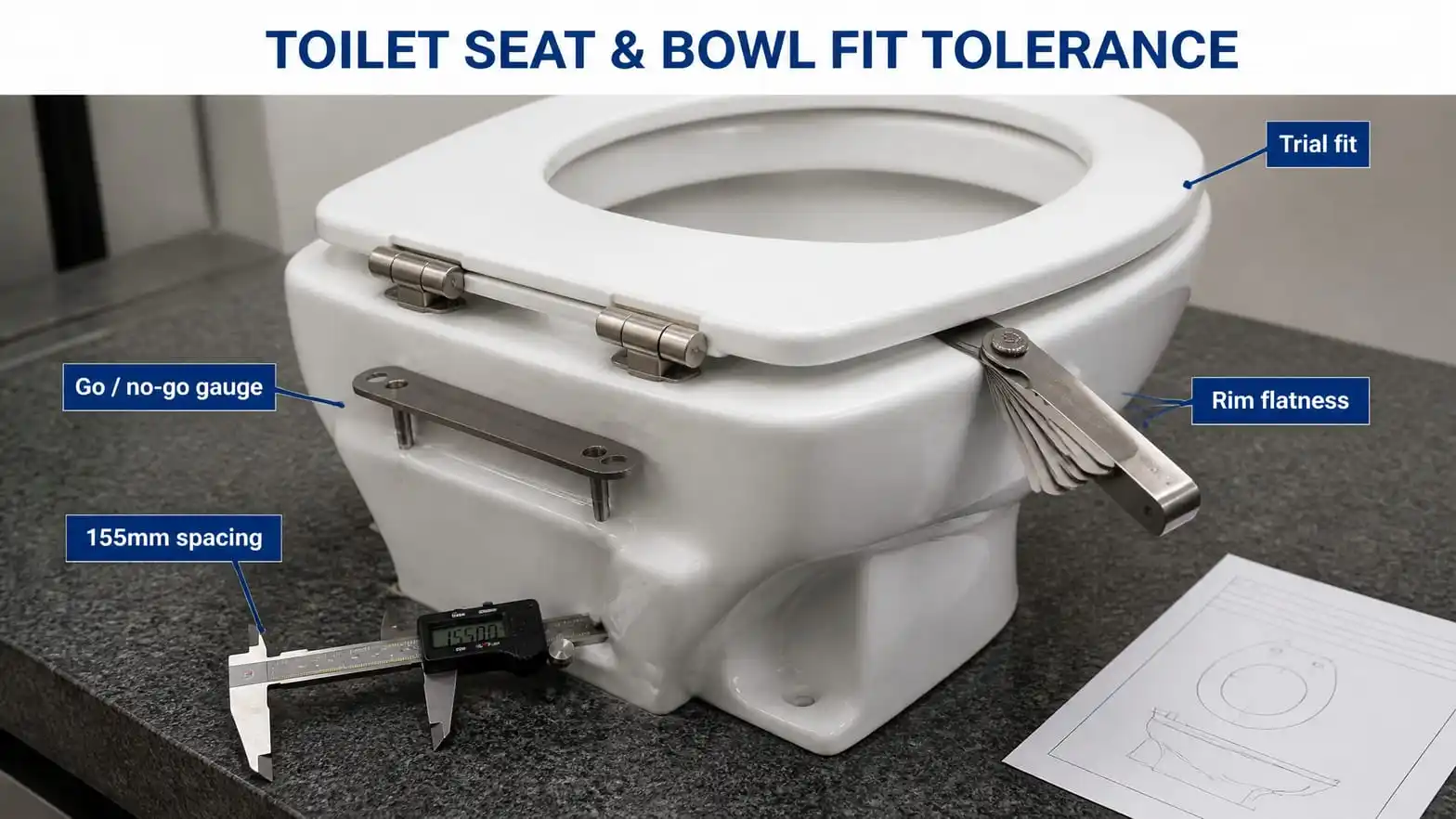
Figure 1: A real ceramic dimension inspection station - the full-size bowl with trial-fitted seat, the digital caliper, and the two-pin hole spacing gauge on the granite surface plate.
1. Why Seat-to-Bowl Fit Is a Functional Specification
The seat is the highest-touch part of the fixture, but most buyers treat it as a commodity accessory. It is not. A rocking seat concentrates stress on the hinge studs until one fractures; a seat on a warped rim transmits movement into the bowl and the floor; a gap between seat and rim collects dirt and defeats the hygiene purpose of the fixture.
The ceramic side of the problem is physics. A toilet bowl shrinks 8–12% during firing, and the thin rear deck that carries the seat post holes shrinks at a different rate than the thick trapway and base. A green-ware bowl that is dimensionally perfect will show 1–3mm of drift in seat post spacing after the kiln. That is why fit tolerance is inspected as its own gate: a bowl can pass flush performance and leak testing and still fail the seat-fit gate.
The seat side is manufacturing, not ceramic. UF and PP seats are molded with hinge spacing fixed per model, so the bowl is almost always the variable side of the pair. Yingjie's toilet line runs a 100% dimensional check on every unit - including seat-post spacing - before packing, with seats built to match. You can review the complete range on the toilet category page.
2. The Three Fit Dimensions That Decide Compatibility
Seat-to-bowl fit is controlled by exactly three dimensions. Everything else - hinge design, soft-close mechanism, bolt material - is secondary:
| Fit dimension | Standard spec | Failure mode when out of spec |
|---|---|---|
| Seat post hole spacing | 155mm ±1.5mm (where applicable) | Rocking seat, forced bolts, cracked ceramic around holes |
| Seat post hole diameter | Ø8–10mm typical, e.g. Ø10 +0.5/-0.0 | Bolt will not insert; seat slop and grommet failure |
| Rim flatness | ≤2mm across the diagonal | Rocking, hinge stress, visible gap, noise |
3. Seat Post Hole Spacing: 155mm ±1.5mm - Where It Applies, and Where It Does Not
The governing number for bowls engineered to the metric pattern is 155mm ±1.5mm center-to-center, where applicable - "where applicable" is deliberate, because the hole pattern is defined by the model drawing, not by a universal law:
| Pattern | Typical spacing | Where it applies |
|---|---|---|
| Metric standard | 155mm ±1.5mm | Two-piece and one-piece bowls designed to the metric pattern; confirm against the model drawing |
| North American 5.5in | ≈140mm (5.5in) | Bowls specified to the inch-based pattern; check the drawing, not the market |
| Integrated smart seat | No posts | Smart toilets whose electronic seat is fixed by the manufacturer |
| Wall-hung / back-to-wall | Manufacturer-defined | Seat hinges mount to the pan or carrier per model |
| One-piece concealed hinge | Manufacturer-defined | Hinges hidden under the skirt; pattern fixed by the factory |
Obtain the model drawing or the dimensional report before you buy, and check the seat post spacing against that document. Ordering a "standard seat" for a batch of mixed models is how misalignment happens.
4. Hole Diameter: The Second Half of the Hole Spec
The seat bolt (typically M8 with a rubber grommet) must enter the hole with a controlled amount of clearance. A typical export spec is Ø10mm +0.5/-0.0: the hole may be slightly larger than nominal, never smaller. Diameter is checked with plug gauges, not calipers, because the holes are not perfectly round after firing:
| Gauge | Function | Pass condition |
|---|---|---|
| GO plug Ø10.0 | Verifies minimum diameter | Must enter the hole freely |
| NO-GO plug Ø10.5 | Verifies maximum diameter | Must not enter the hole |
If the GO plug will not enter, the bolt cannot be inserted without reaming - and reaming a glazed hole is how cracks start. If the NO-GO plug enters, the grommet will not seal and the seat will slop. Measure both holes at two axes, because firing distortion makes holes slightly oval.
5. Rim Flatness: The ≤2mm Diagonal Rule
The seat ring has to sit on the rim over its full perimeter. If the rim is out of plane - warped during drying, distorted in the kiln, or sprung at demolding - the seat touches at two corners and rocks on the other two. The release criterion is rim flatness ≤2mm across the diagonal.
- Set the bowl upright on a granite surface plate.
- Lay a calibrated straight edge across one diagonal of the rim.
- Insert feeler gauges at the deepest gap; record the reading.
- Repeat on the other diagonal; the larger reading is the rim flatness.
- For higher precision, sweep a dial indicator around the rim and record max–min deviation.
Why 2mm matters: the hinge studs sit at the rear of the rim, so a flatness error concentrates at the hinge line - the exact point where rocking stress fractures studs. On rimless and open-front seat designs the contact band is narrower, so the same 2mm error produces a more visible gap. Check the seat side too: lay the seat ring on the plate, because a warped molded seat rocks on a perfect bowl.
6. Tank-to-Bowl Fit: The Second Interface on a Two-Piece Toilet
The same fit logic applies to the tank-to-bowl joint. Tank bolts pass through the tank floor into the bowl's rear deck, and the tank gasket seals between the two flat surfaces. Two checks matter:
| Check | Spec (typical, model-defined) | Gauge |
|---|---|---|
| Tank bolt hole alignment (tank vs bowl deck) | Manufacturer-defined pattern | Model-specific go/no-go alignment fixture |
| Tank sealing surface flatness on bowl deck | ≤2mm across the deck | Straight edge + feeler, or dial indicator |
A tank that rocks on a warped deck crushes the gasket unevenly and weeps at the joint within months - the most common "leaking toilet" complaint that is actually a dimensional defect. Fixture it, don't measure it repeatedly.
7. Tolerance Stack: Why Two In-Spec Parts Can Still Fail to Fit
Individual tolerances combine. Consider a worst-case pair where every part sits at its limit:
| Variable | Nominal | Tolerance | Worst case |
|---|---|---|---|
| Bowl seat post spacing | 155mm | ±1.5mm | 156.5mm |
| Seat hinge stud spacing | 155mm | ±1.0mm | 154.0mm |
| Spacing mismatch between the two | - | - | 2.5mm |
| Stud diameter | Ø8.0mm | ±0.1mm | 8.1mm |
| Bowl hole diameter | Ø10.0mm | +0.5/-0.0 | 10.5mm |
| Radial clearance per stud | - | - | (10.5 − 8.1) ÷ 2 = 1.2mm |
| Lateral shift needed per stud | - | - | 2.5mm ÷ 2 = 1.25mm |
The mismatch needs 1.25mm of lateral shift per stud, but only 1.2mm of clearance exists. The result: a forced fit - the seat goes on with a mallet, the grommets shear, or the installer drills the ceramic. Every individual part was in spec; the pair failed anyway. The fix is to specify the fit, not just the parts: add a seat trial-fit to the release criteria of every bowl batch, and keep the seat supplier and the bowl factory aligned on the same 155mm nominal.
8. Batch Compatibility: Mold Wear, Firing Drift, and the Cross-Batch Trial Fit
Molds are retired at roughly 90–100 cycles, and each new mold shifts the casting slightly. Firing shrinkage drifts with slip recipe and kiln temperature by the hour. Bowl batch N and batch N+100 can differ by more than the seat's hinge tolerance - even though both passed their own inspection.
Because seats are built to the 155mm standard, cross-batch - and usually cross-brand - compatibility is expected whenever both sides hold nominal. What keeps it true in practice:
- Master seat sample. Keep one golden seat per model. Trial-fit it against every new bowl batch at the factory gate.
- Master gauge. A two-pin go/no-go gauge is the fastest batch-release check; the GO side accepts at the lower limit, the NO-GO side rejects past the upper limit.
- Cpk record. Ask for process capability (Cpk ≥1.33) on seat post spacing; a stable process drifts less than an uncontrolled one.
- Documented release. The per-batch dimensional report should list seat post spacing, hole diameter, and rim flatness with date, kiln, and inspector.
Yingjie holds these records per batch for every exported toilet and publishes the dimensional check as part of the 100% factory inspection program described on the toilet category page.
9. Incoming Inspection: A 10-Point Receiving Checklist
When the container arrives, run this checklist before the stock goes to the warehouse:
| # | Check | Method | Accept criteria |
|---|---|---|---|
| 1 | Model and PO match | Packing list + carton labels | Exact model, quantity, finish |
| 2 | Seat post spacing | Two-pin go/no-go gauge | 155mm ±1.5mm (where applicable) |
| 3 | Hole diameter | GO/NO-GO plug gauges | GO enters, NO-GO does not |
| 4 | Rim flatness | Straight edge + feeler, both diagonals | ≤2mm |
| 5 | Seat trial-fit | Mount seat with bolts and grommets | Studs enter freely, no rocking |
| 6 | Tank deck alignment (two-piece) | Model alignment fixture | Bolts align, gasket surface flat |
| 7 | Soft-close hinge function | Hand test, 10 cycles | Smooth close, no drop or slam |
| 8 | Batch traceability | Record batch numbers per carton | Traceable to kiln date and QC records |
| 9 | AQL sampling | ISO 2859-1, general level II | AQL 2.5 critical / 4.0 major |
| 10 | Measurement log | Record all readings per carton sampled | Repeatable, dated, signed |
A supplier that can produce a dimensional report for every batch - with measurements, not just a pass stamp - is a supplier whose corrective action you can verify. That is the standard Yingjie holds for its own production, and the standard worth writing into your purchase order. You can read more about the company's factory and quality setup on the About Us page.
📚 Related Reading
Frequently Asked Questions
What is the standard toilet seat post spacing?
155mm ±1.5mm center-to-center, where the metric pattern applies. Some North American-specified bowls use a 5.5in (≈140mm) pattern, and smart toilets or one-piece models with concealed hinges use manufacturer-defined patterns. Always verify against the model drawing or the dimensional report.
Why does the seat rock even though the bowl passed inspection?
The most common cause is a tolerance stack: bowl spacing at 156.5mm against seat stud spacing at 154.0mm consumes all available hole clearance, so the studs bind or the ring sits unevenly. Check spacing on both parts, not just the bowl, and trial-fit the actual seat.
How do I measure rim flatness on a toilet bowl?
Set the bowl upright on a granite surface plate, lay a calibrated straight edge across each diagonal, and measure the deepest gap with feeler gauges. The larger reading of the two diagonals must be ≤2mm. A dial indicator sweep gives higher precision.
Can a seat from one batch fit a bowl from another batch?
Normally yes, when both hold the 155mm standard - seats are built to fit the standard pattern. Mold wear and firing drift make a cross-batch trial fit necessary: keep a master seat sample and trial-fit it against every new bowl batch, with a go/no-go gauge for the quick release check.
What tools do I need for incoming seat-fit inspection?
A two-pin go/no-go spacing gauge, GO/NO-GO plug gauges for the hole diameter, a calibrated straight edge, a feeler gauge set, and optionally a granite surface plate and dial indicator for flatness. Total tooling cost is well under what one field rework visit costs.
📐 Get Fit Tolerance Inspection Support
Setting up a seat-fit inspection standard for a bulk order? Contact Yingjie Bath for hole-spacing gauge recommendations, per-batch dimensional report templates, and arrival inspection support.
👉 Request Fit Tolerance Inspection Support