
A mechanical and architectural specification guide for concealed cistern flush plates comparing flexible pneumatic tube actuators and direct mechanical linkage rods, operating actuation forces (≤ 15 N), vandal-resistant stainless steel faceplates, and maintenance accessibility.

Commercial Wall-Mounted Brushed Stainless Steel Dual-Flush Actuator Plate
1. Actuation Engineering & Dimensional Matrix: Push Plates
Concealed cisterns conceal bulky plumbing behind tiled walls, leaving only the flush plate visible. Selecting between direct mechanical rod actuators and remote pneumatic push buttons determines installation flexibility, tactile actuation force, and long-term commercial reliability.
| Actuation & Material Variable | Direct Mechanical Linkage Plate | Remote Pneumatic Air-Piston System |
|---|---|---|
| Actuation Drive Mechanism | Direct rigid threaded plastic linkage push rods | Flexible pneumatic micro-tubes with air bellows |
| Mounting Location Freedom | Must be mounted directly over cistern access opening | Can be mounted anywhere within 1.5 to 3.0 m radius |
| Tactile Operating Force | Crisp mechanical feedback; actuation force 12–15 N | Soft pneumatic cushion; actuation force 8–12 N |
| Maintenance Access Door | Actuator plate serves as primary service hatch | Requires separate cistern inspection access panel |
| Vandal Resistance Standard | Heavy-gauge 1.5 mm 304 stainless steel faceplate | Compact remote solid brass / stainless button |
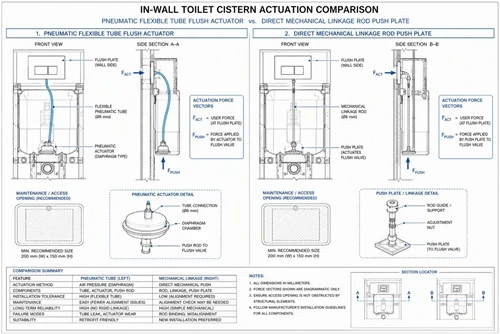
3D CAD Comparison: Pneumatic Air-Piston Drive vs Mechanical Direct Linkage Rods
2. Linkage Kinematics & Pneumatic Fluid Pressure Mechanics
- Direct Mechanical Rod Linkage: Dual adjustable rods transfer finger pressure directly to the flush valve lifting arms, providing immediate mechanical feedback and zero air-pressure leakage over time.
- Pneumatic Air-Piston Dynamics: Compressing the push button forces air through flexible tubing to expand an internal bellows over the flush valve, allowing flexible placement on vanity counters or side walls.
- Dual-Flush Calibration: Independent small (3.0L) and large (4.8L) push buttons are mechanically separated to ensure clear user selection and maximize building water conservation.
3. Project Specification & Quality Audit Checklist
- In-wall rough-in inspection box trimmed flush with finished tile surface.
- Mechanical linkage rods adjusted precisely to cistern depth using calibration clip screws.
- Pneumatic air tubes connected securely with barbed push-fit connectors (zero air leaks).
- Dual-flush actuation buttons tested for distinct 3.0L and 4.8L discharge cycles.
- Actuator plate mounting bracket secured with vibration-resistant spring retention clips.
- Vandal-resistant hidden set screws tightened with hex key on underside of faceplate.
- Service hatch removal tested: allows complete removal of fill and flush valves in < 2 minutes.
- Fingerprint-resistant PVD coating verified clean and streak-free across metal surface.
Frequently Asked Questions (FAQ)
Which actuator system is more reliable for high-traffic public commercial restrooms?
Direct mechanical linkage plates in heavy-gauge 304 stainless steel are most reliable for high-traffic public restrooms because they eliminate flexible air tubes and withstand aggressive public handling.
Can a pneumatic flush button be installed on a bathroom countertop or vanity side panel?
Yes. Pneumatic actuators utilize flexible air tubes that can route through wall cavities, allowing flush buttons to be installed anywhere within a 2-meter radius of the concealed cistern.
Source Certified Commercial Sanitary Ware with Yingjie Bath
Yingjie Bath delivers high-pressure casting vitreous china toilets, basins, and urinals with CE, cUPC, and WaterSense compliance for global distributors and project developers.
Request Project Quotation & Submittal Files